
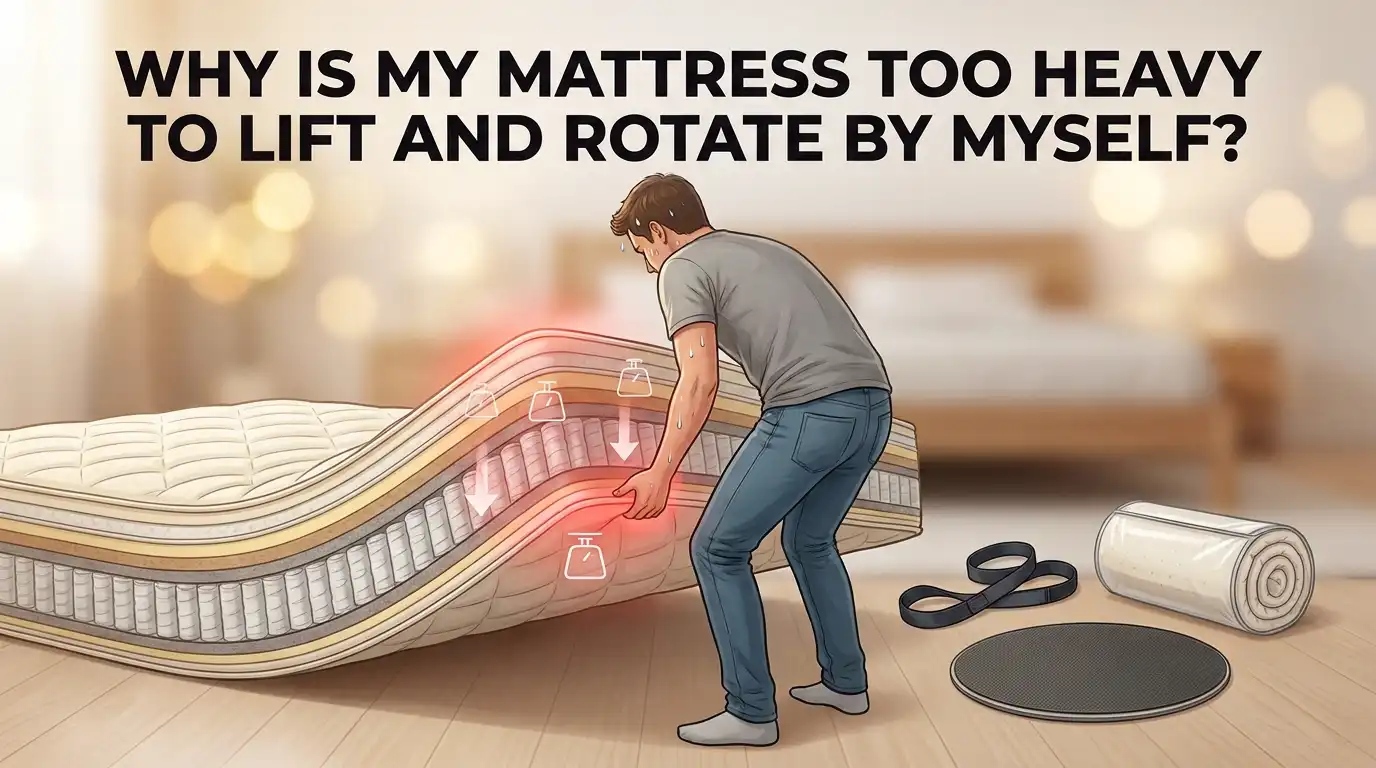
Why Is My Mattress Too Heavy To Lift And Rotate By Myself?
Have you ever tried to rotate your mattress and felt like it was fighting back? You are not alone. Many mattresses today weigh well over 100 pounds, making them tough to budge for one person.
This weight is not a design flaw. It comes from thick comfort layers, dense foam, and sturdy coils that keep you supported all night.
Modern mattresses are built to last, but that durability adds serious bulk. That bulk turns a simple chore into a real workout.
The good news? You do not need to struggle through this task alone or risk hurting yourself.
In a Nutshell
- Mattress weight comes from quality materials. Thick foam, coils, and layers add comfort. They also add serious bulk that makes solo lifting hard.
- Rotate, don’t flip. Most modern mattresses are one-sided. Flipping them can damage the internal support structure.
- Rotating 180 degrees is the safer choice. It helps your mattress wear evenly and stay comfortable for longer.
- Always get help before you rotate. Two people can lift and turn a mattress much more safely than one person alone.
- Protect your back during the lift. Bend at your knees and lift with your legs. Never twist or strain your lower back.
- Clear the room first. Remove clutter and trip hazards around your bed before you start moving anything.
- Stick to a regular rotation schedule. This simple habit keeps your mattress supportive and helps it last for years.
What Makes Mattresses So Heavy Today
Modern mattresses weigh significantly more than older models because they contain multiple layers of premium materials stacked together. Each layer serves a specific purpose, and manufacturers use thicker, denser foam to improve comfort and support.
The foam layers are the biggest weight contributor. High density foam provides better pressure relief and lasts longer than thin foam. Memory foam, gel infused foam, and latex all add substantial weight compared to basic materials. A queen size mattress can easily contain 20 to 30 pounds of foam alone.
Underneath the foam sits a support core made of steel coils or high density base foam. Coil systems use hundreds of individual springs wrapped in fabric. These coils create durability and bounce, but they add considerable weight to the overall structure. A queen coil system can weigh 40 to 60 pounds by itself.
Additional layers increase the total weight even more. Most mattresses include quilted covers, fire barrier layers, and edge support systems. These components protect your investment and improve the mattress lifespan, but they add bulk.
Quality materials mean durability. Manufacturers pack more material into each mattress because people expect comfort and longevity. A mattress that lasts ten years needs stronger construction than a budget model that might last three years.
The cumulative effect is substantial. A standard queen mattress today weighs between 100 and 150 pounds. King sizes often exceed 150 pounds. This weight makes solo lifting dangerous and nearly impossible for most people.
Understanding this weight distribution helps explain why rotation requires assistance. The density and material composition that make modern mattresses comfortable also make them challenging to move safely.
Why Rotating Your Mattress Actually Matters
Rotating your mattress regularly keeps it comfortable and extends its lifespan. When you rotate a mattress, you flip it 180 degrees so the head end becomes the foot end. This simple action distributes wear evenly across the entire surface.
Why does this matter? Your body weight creates pressure points on your mattress every single night. Over time, these areas compress more than others. The head and foot sections get lighter use, while the middle section bears most of your weight. Without rotation, your mattress develops permanent body impressions and loses support in the places you need it most.
Regular rotation prevents these problem areas from forming. It gives compressed sections time to recover while fresh areas take on the nightly pressure. This process keeps the mattress feeling consistent and supportive throughout its entire life.
How often should you rotate? Most experts recommend rotating every three to six months. Some people prefer monthly rotations for the first year, then switch to a longer schedule afterward. The exact timing depends on your mattress type and personal preference.
One important note: Modern mattresses are almost always one-sided. This means you should rotate them, never flip them completely over. Flipping a one-sided mattress exposes the bottom layers, which are not designed for direct contact with your body. This damages the support structure and ruins the mattress.
Rotating protects your investment and keeps you comfortable. It prevents sagging and maintains the firm support your spine needs. The effort you put into regular rotation pays off with years of better sleep and a mattress that lasts longer. This is why the task matters so much for mattress longevity.
The Physical Risks of Lifting a Mattress Alone
Lifting a mattress alone puts your body at serious risk. Your back is particularly vulnerable because mattresses are awkward to grip and heavy to support. When you attempt this solo, you’re more likely to use improper form, which strains your lower back and can cause injury.
Your spine needs protection. Mattresses don’t have handles or natural grip points. You end up holding the fabric or foam edges, which means your arms can’t distribute weight evenly. This forces your back to compensate, creating dangerous stress on your spine.
Injury happens quickly. A single lifting mistake can cause muscle strains, herniated discs, or ligament damage. These injuries often develop over time, meaning you might not feel pain immediately. By the time symptoms appear, the damage is already done.
Your body positioning matters significantly. When you’re alone, you can’t maintain proper alignment. You’ll likely twist your torso, bend awkwardly, or shift your weight unevenly. These movements are exactly what causes long term back problems.
The risk extends beyond your back. Dropping a mattress on yourself or nearby objects creates additional hazards. You might lose your grip mid lift, stumble backward, or pinch fingers and hands. Mattresses are too large to control safely with just two hands.
Getting help is the smart choice. Two people can lift a mattress smoothly and safely. Each person handles one side, distributing weight evenly. Your body stays properly aligned, and the task completes quickly.
Don’t ignore this risk. Back injuries can affect you for years and limit your daily activities. Mattress rotation takes just minutes with assistance, but a back injury can cause months of pain and frustration.
How to Prepare Your Space and Mattress Before Rotating
Before you rotate your mattress, take time to prepare your space and the mattress itself. This preparation makes the entire process safer and easier for you and your helper.
Start by clearing the area around your bed completely. Remove pillows, blankets, and any items on nightstands. Check the floor for toys, cords, shoes, or other objects that could cause tripping. A clear path gives both of you room to move without obstacles.
Next, inspect your mattress for any damage or stains. Look at all sides while it’s still on the bed. Note any areas that need attention before rotation. This is a good time to spot problems early.
Open windows or turn on a fan in your bedroom. Mattresses benefit from fresh air exposure during rotation. This helps eliminate odors and moisture that build up over time.
Make sure you have enough space to maneuver. Your mattress needs room to rotate 180 degrees. If your bedroom feels cramped, consider moving furniture temporarily to create workspace.
Wear comfortable, loose clothing that allows free movement. Avoid baggy sleeves that could catch on the mattress. Put on shoes with good grip and support.
Gather your helper before you begin. Brief them on the plan so you move together as a team. Explain that you’ll rotate the mattress 180 degrees, not flip it end to end.
Check that both of you feel physically ready. If either person is injured, sick, or tired, reschedule the rotation. Your safety matters more than completing the task today.
These simple preparation steps prevent accidents and make rotation quicker for everyone involved.
Proper Lifting Technique for Heavy Mattresses
Lifting a mattress correctly protects your body from injury. Your legs contain the strongest muscles in your body, so use them to do the work.
Start by standing close to the mattress. Position your feet shoulder width apart. Keep your knees slightly bent and ready to engage.
Bend at your knees, not your waist. This simple change shifts the load from your vulnerable spine to your powerful leg muscles. Your back should stay straight throughout the entire lift. Imagine a string pulling the top of your head toward the ceiling.
Grip the mattress firmly on both sides. Use your hands to guide the movement, not to pull the weight. Let your legs do the heavy lifting as you rise slowly and smoothly.
Never twist your spine while holding the mattress. Twisting creates dangerous stress on your discs and muscles. Instead, move your feet to change direction. Pivot with your whole body as one unit.
Keep the mattress close to your body as you lift and move it. The farther the weight sits from your core, the harder your back must work. This increases injury risk significantly.
Move slowly and deliberately. Rushing causes mistakes and strains. Take breaks if you feel tired or uncomfortable.
Most importantly, do not attempt this alone. Two people distributing the weight make rotation safe and efficient. Your helper should use the same proper technique on their side. Communicate clearly during the lift so both people move together.
When both people lift correctly, the mattress feels manageable and the rotation completes without injury risk.
Rotating vs Flipping: Why the Difference Matters
Modern mattresses and older mattresses work very differently. Understanding this difference explains why rotation matters so much and why flipping can actually harm your mattress.
Most new mattresses are one-sided. They have a specific top layer designed for sleeping. The bottom side contains support materials that should never face upward. Flipping a one-sided mattress damages the support structure and ruins comfort. You end up sleeping on materials never meant for that purpose.
Older mattresses, particularly traditional innerspring models, were often two-sided. Both sides had identical support. Flipping worked fine because the mattress performed the same way upside down. Today’s foam, hybrid, and gel-infused mattresses simply don’t work that way.
Rotation is the correct solution. You turn the mattress 180 degrees, moving the head end to the foot end. This spreads wear evenly across the sleeping surface. The same top layer still faces upward. Support materials stay in their proper position. Your mattress maintains its intended structure and comfort.
Why does this matter for lifting? A mattress you flip requires different handling than one you rotate. Flipping demands more dramatic movement and positioning. Rotation is simpler but still requires proper technique and assistance. Both tasks are too heavy for one person, but understanding the difference helps you communicate clearly with your helper about what you’re actually doing.
Check your mattress manual to confirm whether it’s one-sided or two-sided. Most manufacturers clearly state which method to use. Following the right approach protects your investment and keeps your mattress performing well for years. This small detail makes a huge difference in mattress longevity and your sleep quality.
Common Mistakes People Make When Rotating a Mattress
People make several costly mistakes when rotating a mattress, and these errors often explain why the task feels so heavy and difficult.
The first major mistake is attempting rotation alone. Your body cannot safely distribute a mattress’s full weight by yourself. When you try solo, you compensate by using your back muscles instead of your legs. This puts enormous strain on your spine and increases injury risk dramatically. A second person makes the weight manageable and keeps both of you safe.
Another common error is lifting with your back instead of your legs. Many people bend at the waist and pull the mattress toward them. This movement stresses your lower back discs and muscles. Your legs contain much stronger muscle groups designed for heavy lifting. Always bend your knees and keep your back straight when you lift.
People also forget to clear their workspace properly. Clutter around your bed creates tripping hazards. You might stumble while holding a heavy mattress, which causes falls and injuries. Remove all items from the floor before you start.
A significant mistake involves not inspecting the mattress first. You might discover damage, stains, or structural issues that affect how you should handle it. Inspection also helps you identify the best grip points.
Finally, many people confuse rotation with flipping. Modern one-sided mattresses should never be flipped. Flipping damages the support structure and voids warranties. Rotation means turning the mattress 180 degrees so the foot end becomes the head end.
Understanding these mistakes helps you approach mattress rotation safely and effectively. Take your time, use proper technique, and always get help.
How Often Should You Rotate Your Mattress
Most manufacturers recommend rotating your mattress every three to six months for optimal results. This timing helps distribute wear evenly across the surface. If you sleep with a partner, more frequent rotation every three months works better. Your mattress breaks in unevenly when you sleep in the same spot repeatedly.
The exact schedule depends on your mattress type and usage patterns. Memory foam mattresses benefit from rotation every three months. Innerspring and hybrid models handle every six months well. Check your specific mattress manual because different brands have different recommendations.
You’ll notice your mattress needs rotation when one side feels noticeably softer than the other. Sagging in your usual sleeping area signals it’s time to rotate. Some people set phone reminders when they change their clocks for daylight savings time. This simple trick helps you remember twice yearly.
Heavy mattresses make rotation harder, but consistency matters more than perfection. Even if you rotate less frequently than recommended, doing it regularly still helps. Skipping rotation entirely leads to premature sagging and shortened mattress life.
Regular rotation extends your mattress lifespan significantly. Without rotation, you might replace your mattress five to seven years. With proper rotation, quality mattresses last eight to ten years or longer.
The weight issue you’re experiencing makes scheduling even more important. Plan rotations when you have help available. Don’t wait until your mattress is falling apart to start rotating. Starting early prevents the severe sagging that makes rotation feel impossible later.
Final Thoughts
Your mattress feels heavy because of its size, materials, and construction. This is completely normal. Most mattresses weigh between 60 and 150 pounds, depending on size and materials.
You now understand why this happens. Memory foam and hybrid mattresses use dense materials. These materials add comfort but also add significant weight.
The solution is simple. Always rotate, never flip, if you own a modern one-sided mattress. This protects the support layers and extends your mattress life.
Get help every single time. Two people make rotation safe and easy. One person alone risks injury and mattress damage.
Use proper lifting form. Bend your knees, not your back. Let your legs do the heavy work, not your spine.
Clear your workspace first. Remove furniture, toys, or anything blocking your path. This prevents trips and falls during the process.
Stick to a regular schedule. Rotate your mattress every three to six months. Set a reminder so you never forget this task.
Check your mattress manual if you’re unsure about care instructions. It tells you whether your mattress is one-sided or two-sided. This detail matters for proper maintenance.
Inspect your mattress before each rotation. Look for stains, tears, or uneven wear. Catching problems early saves you money later.
Remember these key points going forward. Never attempt rotation alone. Always lift with your legs. Clear your space beforehand. Follow your recommended schedule.
Your mattress weight isn’t going away. But smart habits make the process manageable. Consistency matters more than perfection here.
With the right approach, you’ll keep your mattress in great shape. You’ll also protect your back and body from unnecessary strain. That’s a win for everyone involved.
Frequently Asked Questions
Why does my mattress feel so heavy when I try to rotate it?
Your mattress weighs more than you think. Modern mattresses contain multiple layers of foam, springs, or gel materials stacked together. A queen size mattress typically weighs between 60 and 150 pounds depending on its construction.
The weight also depends on what’s inside. Memory foam mattresses are heavier than traditional spring mattresses. Hybrid models combine both materials, making them even denser.
Your mattress also traps air and moisture inside, which adds extra weight. The larger your mattress, the more materials it contains. This is why rotating feels so difficult.
Can I rotate my mattress alone safely?
No. Attempting rotation solo puts you at serious injury risk. Your back and shoulders aren’t designed to lift and maneuver heavy objects by themselves.
Lifting alone also causes you to use improper form. You might twist your spine or strain your muscles. The mattress could slip and fall on you, causing injury.
Always ask someone to help you rotate. Two people can distribute the weight evenly and move the mattress safely.
What’s the correct way to lift a heavy mattress?
Bend at your knees, not your waist. Keep your back straight throughout the lift. Use your leg muscles to do the heavy work, not your back.
With your helper, lift slowly and steadily. Grip the mattress firmly on opposite sides. Move together as a team. Take breaks if you need them.
Never jerk or rush the rotation. Smooth, controlled movements prevent injury and protect your mattress from damage.
How often should I rotate if it’s so heavy?
Rotate every three to six months for best results. Yes, the weight makes this challenging. Consistency matters more than perfection though.
Mark your calendar so you don’t forget. Regular rotation keeps your mattress wearing evenly and extends its life significantly.

Hi, I’m Ava Day, the founder and lead writer at Cozy Bed Vault. I’m passionate about sleep wellness and dedicated to helping people find their perfect mattress. Through honest reviews, detailed comparisons, and expert buying guides, I simplify the mattress shopping experience so you can sleep soundly every night.