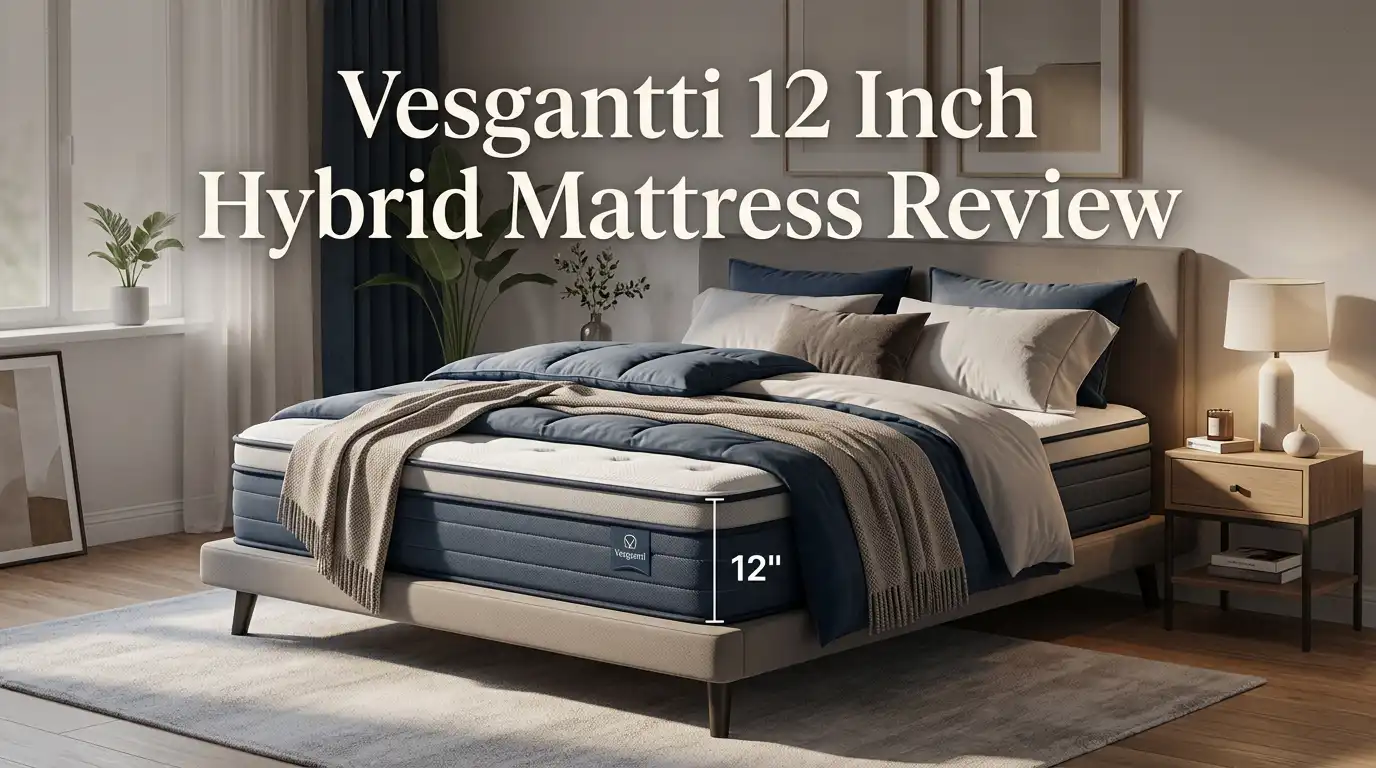
Vesgantti 12 Inch Hybrid Mattress Review 2026: Worth It?
You want a real bed, not a glorified sleeping pad. You also do not want to spend a thousand dollars to get one. That tug of war is exactly where the Vesgantti 12 Inch Hybrid Mattress lives.
It shows up on Amazon with a 4.4 star rating, tens of thousands of ratings, and a price that often sits under three hundred dollars for a queen. That combination makes people stop scrolling.
This review covers what this mattress genuinely does well, and the parts that will frustrate you. No sugar coating. By the end you will know if this bed belongs in your bedroom or in someone else’s guest room.
In a Nutshell:
- The price is the headline feature. A queen often lands near $284, roughly 70% below the average mattress price. For a spare room, a dorm, a rental, or a short term setup, that number is hard to argue with.
- Motion isolation is genuinely good. Lab testing measured about 17% less motion transfer than average, so a restless partner or a dog hopping on the bed will not wake you as often as you expect at this price.
- Pressure relief is the big weakness. The comfort layer measures only 2 inches, and roughly half of that is the quilted cover. Testers rated pressure relief 4 out of 10, which means hips and shoulders feel the springs.
- Off gassing lasts longer than normal. The smell took about 11 days to fade in testing, compared to a 6 day average. Plan for an open window and a ventilated room.
- Edge support splits in two. Sitting on the edge feels surprisingly solid, but lying near the edge feels soft and unsupported, which shrinks the usable sleep surface.
- Coverage is modest but real. You get a 100 night trial, a 10 year limited warranty, free shipping, and free returns.
Vesgantti 12 Inch Hybrid Mattress

Last update on 2026-10-18 / Affiliate links / Images from Amazon Product Advertising API
This is a mattress in a box that leans hard on springs. Vesgantti calls it a hybrid, and technically that label fits, since you get foam over pocketed coils. In practice it feels closer to a traditional innerspring bed. The spring unit does the heavy lifting, and the foam sits on top like a thin blanket rather than a cushion.
The build includes a quilted knit cover, a layer of poly foam, and a tall pocketed coil base. Vesgantti markets it as fiberglass free, which matters to a lot of shoppers after years of fiberglass horror stories from other budget brands. It arrives compressed, rolled, and sealed in plastic, with carrying handles stitched into both long sides.
The sales copy promises ergonomic support and pressure relief. The reality is more modest, and we will get to that honestly below.
The Unboxing Experience
The box arrives heavy. A queen weighs around 87 pounds, so grab a second person or plan to drag it. The carrying handles help more than you think, especially on stairs and through narrow doorways.
Inside, you get a tightly rolled cylinder wrapped in thick plastic. Cutting the plastic is the fun part. The mattress hisses, swells, and unfolds across the frame within a minute or two. Most of the expansion happens in the first hour. Full loft takes 24 to 72 hours, and the corners are usually the last part to fill out.
Then comes the smell. It is strong, chemical, and immediate. Open a window before you cut the plastic, not after. The mattress is firmer than expected on night one and softens slightly over the first week as the foam relaxes.
What Is Inside the Mattress
Transparency is not this brand’s strong suit, so here is the measured breakdown instead of the marketing version. Independent testing found three layers inside the profile.
The top is a quilted cover roughly 1 inch thick, made of polyester. Below that sits a 1 inch poly foam comfort layer. Underneath both is a 9.5 inch pocketed coil unit, which makes up more than 80% of the total height.
That ratio tells the whole story. Average mattresses carry about 4.2 inches of comfort material. This one carries 2 inches, and the cover counts toward that total. You are essentially sleeping on springs with a quilt over them.
The coils are individually wrapped, which explains the good motion isolation, but there are no reinforced edge coils and no zoned support. The foam quality also drew criticism in testing, which raises fair questions about how it holds up after a year or two.
Top 3 Alternative for Vesgantti 12 Inch Hybrid Mattress


Last update on 2026-10-17 / Affiliate links / Images from Amazon Product Advertising API
Linenspa 12 Inch Hybrid Mattress

Last update on 2026-10-16 / Affiliate links / Images from Amazon Product Advertising API
Sweetnight 12 Inch Plush Pillow Top Hybrid Mattress

Last update on 2026-10-16 / Affiliate links / Images from Amazon Product Advertising API
Zinus 12 Inch Green Tea Memory Foam Mattress
Firmness and Feel
Vesgantti sells this bed in one firmness only. Testers placed it at 6 out of 10 on the firmness scale, which lands in medium firm territory. There is no soft option and no firm option, so you take it or leave it.
The feel is springy rather than hugging. Sinkage measured about 2.12 inches, close to average, but the bounce measured 10.33 inches, well above the 9.27 inch average. That means you sit on the mattress instead of sinking into it. Rolling over is easy. Getting out of bed is easy.
If you love memory foam and that slow cradling sensation, you will not like this bed. If you grew up on classic spring mattresses and miss that responsive push back, the feel will seem familiar and comfortable. Your mattress history matters more than the spec sheet here.
How It Performs for Side Sleepers
This is where honesty hurts. Side sleeping puts your full body weight on two narrow points, your shoulder and your hip. Those points need material to sink into. This mattress does not provide much.
With only 2 inches of comfort material above the coils, pressure builds quickly at the shoulder. Lab pressure mapping showed a peak reading of 0.97 PSI for side sleepers, and testers reported being unable to stay in one position comfortably for long stretches. Pressure relief scored 4 out of 10 overall.
Lighter side sleepers under 130 pounds may manage, especially with a soft mattress topper added on day one. Heavier side sleepers will likely feel the springs through the foam. If you sleep on your side every night, treat this as a bed that needs an upgrade layer, not a finished product.
Back and Stomach Sleepers
Back and stomach sleepers have a better experience, though still not a great one. Both positions spread weight across a wider surface, so the thin comfort layer causes less trouble. Pressure mapping recorded 0.08 PSI average for back sleepers and 0.10 PSI for stomach sleepers, lower than the side sleeping numbers.
Stomach sleepers in particular benefit from the firm feel, because the hips stay closer to level with the shoulders. That reduces the lower back arch that soft beds cause. The 9.5 inch coil unit keeps the midsection supported.
Still, independent testers did not recommend this mattress for any weight group or any position, mainly because of comfort layer quality. My practical read: back and stomach sleepers can live with it, side sleepers will fight it. Adding a 2 inch topper fixes much of the complaint for very little extra money.
Motion Isolation for Couples
Here is the pleasant surprise. Spring heavy mattresses usually transfer motion across the bed. This one does not.
Testing measured an acceleration range of 7.27 m/s, about 17% below the 8.74 m/s average. The individually pocketed coils move on their own rather than as a connected grid, so a partner shifting at 2 a.m. creates a local disturbance instead of a wave. Motion isolation scored 9 out of 10.
The one catch is duration. Movement settled in about 1.04 seconds, slightly longer than average, because that bouncy coil unit keeps vibrating briefly after impact. So the movement is small, but it lingers a beat.
For couples on a tight budget, this is the strongest argument in the mattress’s favor. You rarely get this level of motion control under three hundred dollars.
Edge Support Reality Check
Edge support behaves strangely on this bed. Sitting on the edge, the mattress holds up well. Testers measured 4.50 inches of compression while seated, and the structure kept its shape enough to put on shoes or sit while reading.
Lying near the edge is a different story. Support was rated poor in every sleeping position. Within a few inches of the perimeter, the midsection sinks and the surface rolls away under you.
The reason is simple. There are no edge support foam rails and no reinforced perimeter coils. Combine that with 2 inches of soft comfort material and nothing holds the border firm.
Practically, this shrinks your usable sleeping area. Couples who sleep spread out on a queen will notice. Anyone who sits on the bed edge daily will not.
Cooling and Temperature Control
Temperature performance is fair, not excellent. Testing recorded a maximum surface temperature of 90.9 F against an 89.8 F average, which puts it slightly warmer than typical. The cooling score came in at 7 out of 10.
There is logic behind that result. Less foam means less heat trapping material, and the coil unit allows air to move through the core. That airflow helps. The quilted polyester cover also breathes reasonably well.
The problem is the poly foam layer itself, which does not vent heat efficiently. Testers reported isolated warm spots, especially under the mid back where body contact is heaviest. The rest of the surface felt warm rather than hot.
So hot sleepers will not roast, but they will not feel the cool to the touch sensation the marketing suggests either. A breathable cotton sheet set makes a noticeable difference.
Off Gassing and the First Week Smell
Every compressed mattress smells. This one smells longer. Testing recorded a strong initial odor that took 11 days to fully clear, nearly double the 6.4 day average.
That is a real inconvenience, not a minor footnote. If you ordered this as your only bed and you are sensitive to chemical smells, you may have an unpleasant week ahead. People with asthma or fragrance sensitivity should take this seriously.
The good news is that off gassing happens once. It does not return, and it does not indicate ongoing emissions after the foam finishes releasing trapped air.
My advice: unbox in a spare room with a window open and a fan running for the first 48 hours. Then let it air out, uncovered, for two or three more days before adding sheets. Patience solves this problem completely.
Noise and Durability Concerns
Two issues deserve a flag here. Noise scored only 4 out of 10 in testing, which is listed as very high. Spring mattresses squeak, and when you have barely 2 inches of material muffling 9.5 inches of coils, more of that sound reaches your ears. Light sleepers may hear the bed respond when a partner moves.
Durability is the bigger worry. Testers described the comfort foams as among the lowest quality they had encountered and voiced concern about how quickly those layers would break down. Thin, low density foam compresses permanently faster than thick, high density foam.
Owner feedback echoes this, with complaints about sagging and body impressions appearing within the first couple of years. Treat this mattress as a short term or secondary purchase rather than a decade long investment. Rotate it every three months to spread the wear.
Pros and Cons
Pros
- Excellent price for a full size spring bed, often under $300 for a queen
- Strong motion isolation, about 17% better than average, which helps couples
- Fiberglass free construction, a genuine relief after other budget brand controversies
- Fast response time of 0.4 seconds, so moving around the bed feels easy
- Good sitting edge support for putting on shoes or perching on the side
- Carrying handles on both long sides make setup and rotation much simpler
- Free shipping and free returns with a 100 night trial window
Cons
- Poor pressure relief, scored 4 out of 10, with only 2 inches of comfort material
- Weak lying edge support, with no reinforced coils or foam rails
- Long off gassing period of roughly 11 days with a strong initial smell
- Noisy springs rated very high for noise in testing
- Questionable foam longevity, with reports of early sagging
- One firmness only, so there is no softer option for side sleepers
- Shorter 10 year warranty and a 100 night trial, both below industry averages
Price and Value
Value depends entirely on expectations. Recent pricing runs around $229 for a twin, $265 for a full, $284 for a queen, and $332 for a king. A typical queen mattress costs roughly $942, so you are paying a fraction of the market rate.
At that price the math changes. You are not comparing this bed to a premium hybrid. You are comparing it to a cheap foam mattress, a hand me down, or sleeping on a frame with nothing on it. Against those options it wins easily.
Add a $60 to $100 topper and the comfort complaint largely disappears, bringing your total to roughly $350. That combination outperforms the mattress alone by a wide margin.
What you should not do is buy this expecting ten years of primary bed service. The materials do not support that claim.
Trial, Warranty and Returns
Vesgantti offers a 100 night sleep trial and a 10 year limited warranty that is not prorated, meaning coverage does not shrink as the years pass. Shipping and returns are both free, which removes the usual risk of buying a mattress online.
Context matters though. The average mattress trial runs about 179 nights, and the average warranty runs 13 years, with roughly one in four brands offering lifetime coverage. So this protection is real but below the industry standard.
Read the warranty terms carefully before you assume you are covered. Budget mattress warranties often require a specific sag depth before a claim qualifies, and they usually demand proper support underneath, meaning a solid platform or slats spaced closely together.
Using the wrong frame can void your coverage entirely. Keep your Amazon order confirmation somewhere safe.
Who Should Buy It and Who Should Skip It
Buy it if you need a guest room bed, furnish a rental property, equip a college apartment, or need something better than your current situation right now. Back and stomach sleepers who prefer a firm spring feel will adapt fastest. Couples who are sensitive to partner movement get real benefit here.
Skip it if you are a dedicated side sleeper, weigh more than 230 pounds, suffer from chronic hip or shoulder pain, or need a mattress to last a decade. Also skip it if you cannot tolerate chemical smells for over a week.
My honest position: this is a good temporary bed and a mediocre permanent one. Buy it with a topper, use the 100 night trial seriously, and judge it after two full weeks rather than two nights. Nobody should expect premium performance at clearance pricing.
Final Verdict
The Vesgantti 12 Inch Hybrid Mattress earns a passing grade, not an enthusiastic recommendation. Independent testing gave it an overall score of 7.12 against an 8.55 average, placing it near the bottom of tested mattresses. That is the fair technical picture.
The human picture is more forgiving. Motion isolation is good, bounce is high, setup is easy, and the price is remarkable. Thousands of owners sleep on this bed every night and rate it 4.4 stars, which suggests expectations play a huge role in satisfaction.
My recommendation is simple. If you need a bed and your budget is firm, buy it and add a topper on day one. Treat the topper as part of the purchase, not an optional extra. If you have $500 or more to spend, better built hybrids exist and your body will thank you.
Frequently Asked Questions
Is the Vesgantti 12 Inch Hybrid Mattress good for back pain?
It can help back and stomach sleepers who need firm support, because the 9.5 inch coil unit keeps the spine level. It is less helpful for hip or shoulder pain, since the 2 inch comfort layer provides limited cushioning. People with chronic pain generally need more comfort material than this mattress offers.
How long does the Vesgantti mattress take to expand?
Most expansion happens within the first hour. Full loft usually takes 24 to 72 hours, and corners fill out last. Sleep on it the first night if you need to, but wait three days before judging the feel.
Does this mattress contain fiberglass?
No. Vesgantti markets the mattress as fiberglass free, and independent testing confirmed no fiberglass in the construction. The cover is listed as 100% polyester.
Can I use this mattress on a box spring?
Yes, as long as the surface is solid and supportive. A platform bed, a bunkie board, or slats spaced within 3 inches apart all work well. Wide slat gaps cause sagging and can void the warranty.
How bad is the smell really?
Strong at first. Testing measured roughly 11 days before the odor fully cleared, which is longer than most mattresses in a box. Ventilate the room with a window open and a fan running for the first two days.
Does it sleep hot?
Mildly warm rather than hot. Surface temperature measured 90.9 F in testing, just above average. The coil core allows airflow, but the foam layer traps some heat under the mid back.
What is the weight limit?
Vesgantti and third party reviews place practical support around 250 pounds per sleeper. Heavier sleepers will compress the thin comfort layer and feel the coils more directly.
Is the warranty worth anything?
The 10 year limited warranty is not prorated, which is positive. However, budget mattress warranties typically require significant sag depth plus documented proper support before a claim qualifies. Keep your receipt and use the correct frame.

Hi, I’m Ava Day, the founder and lead writer at Cozy Bed Vault. I’m passionate about sleep wellness and dedicated to helping people find their perfect mattress. Through honest reviews, detailed comparisons, and expert buying guides, I simplify the mattress shopping experience so you can sleep soundly every night.