Latex For Less Mattress Review 2026: Worth It?
Shopping for a natural latex mattress usually means staring at a $2,000 price tag and wincing. Latex For Less built its entire brand around fixing that problem. The company sells a flippable, two sided natural latex bed that starts around $719 for a twin and lands near $1,109 for a queen.
That price is roughly 28% below the average latex mattress. So the obvious question follows. Does cheaper latex still sleep well, or do you feel every dollar you saved?
I dug through lab test data, owner feedback, warranty fine print, and third party measurements to answer that. This review covers what the mattress gets right, what it clearly gets wrong, and who should skip it entirely.
In A Nutshell:
- The price is the headline feature. A queen runs about $1,109, which undercuts most natural latex competitors by several hundred dollars. Twin sizes start near $719. For buyers who want latex without a luxury budget, this is one of the few doors that stays open.
- It is genuinely flippable, and that matters. One side reads medium, the other reads firm. A small tag tells you which is which. If you guess wrong on firmness, you flip the bed instead of returning it. That flexibility is rare at this price.
- Cooling and bounce are legitimate strengths. Testers reported almost no heat buildup. Response time measured 0.2 seconds to mostly recover, which ties for the fastest in independent lab testing. Combination sleepers will love how easy it is to roll over.
- Pressure relief is the weak spot. Lab scores landed around 6.0 out of 10. The comfort layer measures only about 2.25 to 2.5 inches versus a 4.32 inch average. Strict side sleepers should look elsewhere.
- The smell lasts a long time. One testing lab recorded a strong rubber odor that took a full 30 days to fade, compared to a 7 day average. Plan to air it out before you sleep on it.
- Buy direct, not through Amazon, if you want the trial. The 120 night sleep trial applies only to direct purchases. Amazon buyers get a 30 night window handled through Amazon returns instead.
What Is The Latex For Less Mattress?

Last update on 2026-10-19 / Affiliate links / Images from Amazon Product Advertising API
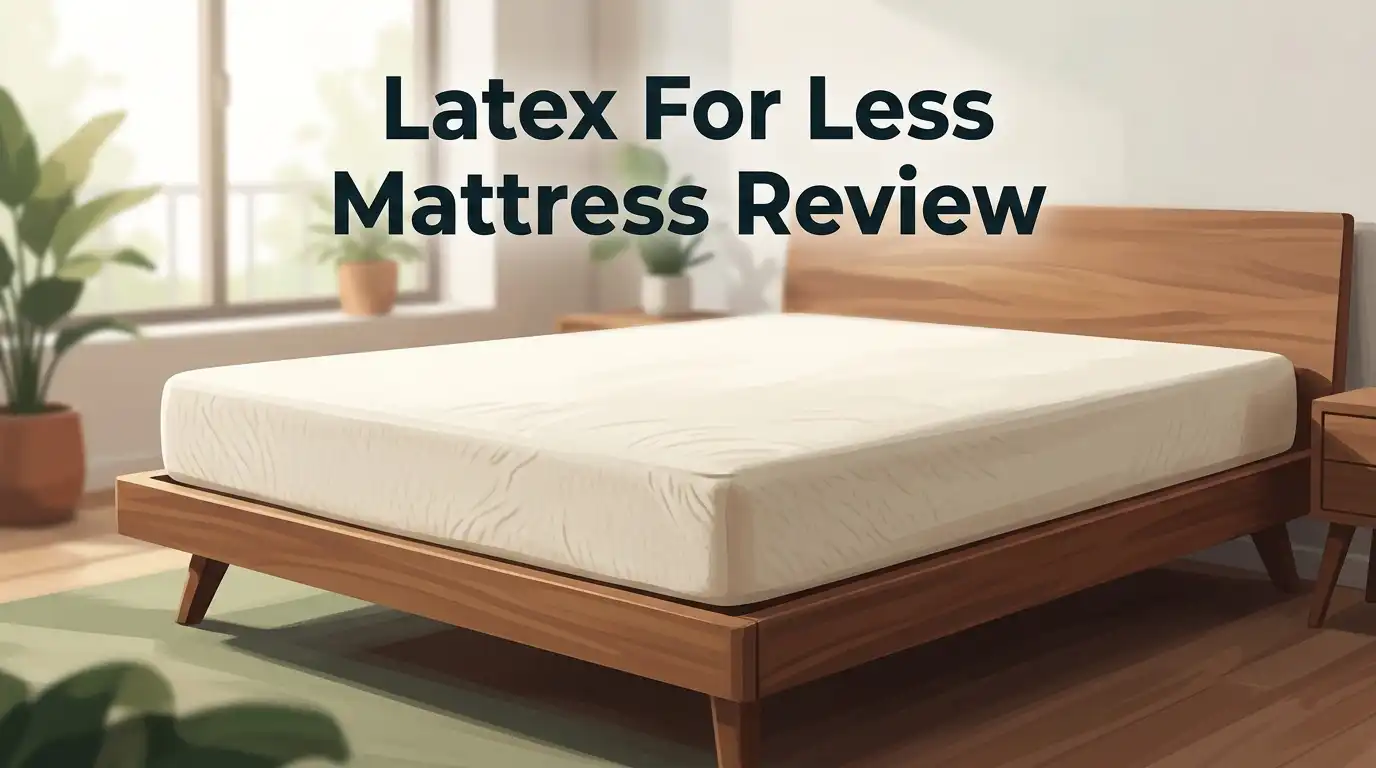
Latex For Less is an online direct to consumer brand run by The Natural Latex Company out of Camarillo, California. The mattress launched in 2014 and has barely changed since, which tells you the design works well enough that the company never felt pressure to redo it.
The flagship product is a two sided natural latex mattress available in 7 inch and 9 inch heights. Both versions are reversible. One side gives you a medium feel, the other gives you firm. You flip the whole mattress to switch.
Every unit uses a GOTS certified organic cotton cover with a half inch of organic wool under it on each side. The wool acts as a natural fire barrier, so the bed skips chemical flame retardants entirely. There is no fiberglass anywhere in this mattress, which is a meaningful win given how many budget beds still rely on it.
The company ships only to the lower 48 states. No Alaska, no Hawaii, no physical showrooms, and no retail partners besides Amazon.
Latex For Less 2 Sided Natural Latex Mattress 9 Inch
The 9 inch model is the one most buyers should consider. It stacks a thinner medium latex layer on top of a thick, dense firm layer, which gives you a real difference between the two sides rather than a subtle one.
On paper the build is 2 inches of medium latex over 6 inches of firm latex, wrapped in wool and organic cotton. In practice, one independent lab measured the layers an inch short of those specs and flagged the base layer as feeling more like polyurethane support foam than latex.
The brand disputes that finding and says the tested unit was not a current production model. Worth knowing, not worth panicking over.
What is not in dispute: the 9 inch version performs better for heavier sleepers and stomach sleepers. Testers over 230 pounds consistently preferred it. If you weigh more than 200 pounds, skip the 7 inch and go straight here.
A queen weighs between 103 and 132 pounds. That is heavy. Get help moving it.
Unboxing And Setup Experience
The mattress arrives roll packed. It gets compressed, vacuum sealed in plastic, and shipped in a box that lands on your doorstep with standard ground shipping. There is no white glove option and no expedited shipping, so you handle everything yourself.
Here is the honest part. This box is heavy and awkward. A queen box weighs over 100 pounds and has no handles. Two people minimum. Three if your bedroom is up a flight of stairs. Drag it on a blanket if you have to.
Once you slice the plastic, the mattress expands fast. Latex does not need 48 hours to decompress the way memory foam does. It takes shape within minutes and feels close to final within an hour.
Then comes the smell. This is the part nobody warns you about enough. One lab recorded a strong rubber odor that persisted for 30 days, versus a 7 day industry average. It smells like a new tire shop, not like chemicals, but it is noticeable. Open a window, run a fan, and give it at least a few days before you sleep on it.
Firmness Levels Explained
Latex For Less markets the two sides as medium and firm. Independent testing suggests both run firmer than the labels imply.
One testing lab rated the medium side a 5 out of 10 and the firm side a 7. Another lab rated the medium side a 7 and the firm side a 9. That is a meaningful gap in opinion, and the truth likely sits between them.
Here is the practical takeaway. The medium side is where most people will land. It feels supportive with light cushioning, not plush. The firm side is genuinely hard. It suits stomach sleepers, heavier back sleepers, and people who grew up on old school firm beds.
Almost nobody describes either side as soft. If you currently sleep on a pillow top and love it, this mattress will feel like a shock. Flipping it does not fix that, because even the softer side sits on the firmer end of the spectrum.
The flip feature still earns its keep. You get a second chance at firmness without a return shipment.
How It Feels For Side Sleepers
This is where Latex For Less struggles most, and I want to be direct about it.
Side sleepers need a mattress to cushion the shoulder and hip while keeping the spine straight. That requires contouring. Latex For Less delivers very little contouring by design. Measured sinkage came in at 1.89 inches versus a 2.26 inch average. You lie on this mattress, not in it.
Testing panels gave side sleepers under 230 pounds a score around 7 to 7.5 out of 10 on the medium side. That is passable, not good. One tester described the pressure relief as “just enough” and nothing more.
On the firm side, side sleeping is rough. One lab marked side sleeping as a flat no across every weight category. Shoulder pressure builds quickly because there is nowhere for the joint to sink.
If you sleep on your side exclusively and you have broad shoulders or wide hips, this is not your mattress. A latex hybrid with a thicker comfort layer will serve you far better.
Top 3 Alternative For Latex For Less Mattress

Last update on 2026-10-19 / Affiliate links / Images from Amazon Product Advertising API
Sleep On Latex Pure Green Organic Latex Mattress


Last update on 2026-10-16 / Affiliate links / Images from Amazon Product Advertising API
Zinus Memory Foam 10 Inch Green Tea Mattress

Last update on 2026-10-19 / Affiliate links / Images from Amazon Product Advertising API
Latex For Less 3 Inch Medium Firm Mattress Topper
How It Feels For Back And Stomach Sleepers
Back and stomach sleepers get the better end of this deal. The firm, flat surface does exactly what these positions need.
Back sleepers scored around 8 out of 10 on the firm side in the 130 to 230 pound range. The mattress holds the midsection up instead of letting it dip, which keeps the lower back from arching. That even surface is the mattress’s best structural quality.
Stomach sleepers did even better. They rated the 9 inch firm side 7.5 to 8 out of 10 across most weight groups. The minimal sinkage prevents the hips from dropping below the shoulders, which is the main cause of stomach sleeping back pain.
One tester who sleeps on both back and stomach noted the bounce made position changes effortless. No sinking, no struggle, no feeling trapped.
If you are a dedicated back or stomach sleeper on a budget, this mattress makes a lot of sense. That is the clearest recommendation in this entire review.
Cooling Performance And Temperature Control
Latex For Less runs cool, and this is not marketing fluff.
Three separate testers reported minimal heat buildup over week long trials. One said there was “basically no heat buildup” at all. The organic cotton cover breathes, the wool wicks moisture, and latex itself resists trapping heat in a way memory foam never manages.
Lab measurements told a slightly more modest story. Max surface temperature hit 92.4 degrees Fahrenheit, which is 2.2 degrees warmer than the tested average. Heat dissipated quickly once weight came off, dropping 6.1 degrees in the first minute.
Here is the nuance. This is an all foam design without coils, so airflow is limited compared to a latex hybrid. You will not get the chimney effect that pocketed coils provide.
Still, for hot sleepers who hate the swampy feel of memory foam, this is a major upgrade. Temperature control rated 7.5 to 8.5 out of 10 depending on which side you use. The firm side runs slightly cooler because you sink in less.
Motion Isolation For Couples
This is the second clear weakness, and couples need to read this section carefully.
Latex bounces. That bounce is wonderful when you want to roll over and terrible when your partner wants to roll over at 3 a.m. Motion isolation scored 5.5 out of 10 in one lab and recorded a 9.66 meter per second acceleration range in another, roughly 10% above average.
Motion also lingered. Vibration took 1.17 seconds to settle versus a 0.90 second average. If your partner is a restless sleeper and you wake easily, you will feel it.
One tester put it plainly: motion transfer is substantial, and it is almost unavoidable given the latex construction.
Fairness note. This is a latex problem, not a Latex For Less problem. Nearly every all latex mattress shares it. If motion isolation ranks as your top priority, you want memory foam or a hybrid with individually wrapped coils, not latex.
Edge Support And Durability
Edge support sits in the acceptable middle. Testers measured 4 inches of compression when sitting on the perimeter, slightly worse than the 3.84 inch average.
You will feel the edge give when you sit to tie your shoes. It does not collapse under you, and the springy latex rebounds instantly once you stand. Lying near the edge feels a bit sunken compared to the center.
The 9 inch firm side offers the strongest perimeter. There is no reinforced edge system, which is normal for an all foam latex bed.
Durability is the brighter story. Latex is the most durable mattress material available, and this bed should realistically last 10 to 15 years. Durability ratings came in at 8.5 out of 10.
The Dunlop latex in the base resists body impressions far better than polyfoam. A 20 year non prorated warranty backs that up, covering sagging of 1.5 inches or deeper. That warranty length beats the 13 year industry average by a wide margin.
Materials And Certifications
The cover uses GOTS certified organic cotton. The wool layers are organic and serve as the fire barrier, which means no chemical flame retardants and no fiberglass anywhere in the build.
The latex itself is advertised as 100% natural, sourced as single origin rubber tree sap. The law tag lists materials as 100% latex foam rubber with a 50% cotton and 50% wool covering. Manufacturing happens in Camarillo, California.
Here is the honest caveat. One independent lab tested a unit and found the base layer measured 1.82 PCF density, consistent with polyurethane support foam rather than the advertised 55 kg per cubic meter latex. Layer thicknesses also came up about an inch short of published specs.
Latex For Less disputed those findings and claimed the tested unit was not a standard production mattress. The lab stood by its testing and noted the unit carried correct branding and law tags. A retest was pending as of mid 2026.
Take this as a reason to inspect your own mattress on arrival, not as proof of wrongdoing. The dispute is unresolved.
Pros And Cons Of Latex For Less
Here is the balanced summary.
Pros
- Price leadership in the natural latex category. A queen at roughly $1,109 sits about 28% below the latex average, opening the material to buyers who would otherwise be priced out entirely.
- Flippable design with two distinct firmness levels. You get a built in second chance if your first firmness guess misses, which removes a lot of purchase anxiety.
- Excellent temperature regulation thanks to organic cotton, organic wool, and naturally breathable latex. Hot sleepers consistently reported no heat buildup.
- Fastest in class response time at 0.2 seconds to mostly recover. Combination sleepers can change positions without fighting the surface.
- Strong durability with a 20 year fully non prorated warranty, well above the 13 year industry average.
- Free ground shipping and free returns on direct orders, plus no fiberglass and no chemical flame retardants.
Cons
- Pressure relief is mediocre. The 2.25 to 2.5 inch comfort layer falls well short of the 4.32 inch average, and lab scores landed around 6 out of 10.
- Motion transfer runs about 10% above average, which makes this a poor choice for light sleepers who share a bed.
- The off gassing smell lasted 30 days in testing versus a 7 day average. It is a rubber odor rather than a chemical one, but it is strong and persistent.
- Side sleepers get limited support, especially on the firm side, where one lab rated side sleeping unsuitable at every body weight.
- Edge support measured slightly below average with no reinforced perimeter.
- The mattress is heavy, has no handles, and requires two or three people to move safely.
- The 120 night trial only applies to direct purchases. Amazon buyers get 30 nights handled through Amazon.
What This Mattress Does Not Do Well
I want to put the negatives in one place so nothing gets buried.
It does not hug you. If you want that sinking, enveloping memory foam sensation, this mattress will disappoint you every single night. Sinkage measured 1.89 inches. You float on top.
It does not isolate motion. Couples with mismatched schedules will feel each other move. One lab recorded a secondary energy spike half a second after the initial movement, meaning the bounce echoes.
It does not arrive odor free. Thirty days of rubber smell is a long time. Budget for airing it out in a spare room if you are scent sensitive.
It does not suit strict side sleepers. Shoulder and hip pressure builds because the comfort layer is too thin to absorb it.
It also does not come with white glove delivery, expedited shipping, Alaska or Hawaii delivery, or a showroom where you can test it first. You buy this one on faith and data.
Pricing, Trial Period, And Warranty
Current pricing runs roughly $719 for twin, $749 twin XL, $969 full, $1,109 queen, $1,529 king and California king, and $1,594 for split king sizes. Sales run often, so the real number may land lower.
The sleep trial deserves careful attention. Direct purchases get 120 nights with a mandatory 30 night break in period. That break in requirement is not unusual, but it means you cannot return the bed in week two no matter how much you dislike it.
Returns require you to box the mattress and arrange shipping yourself, or pay $99 for company pickup. The 120 night window is well below the 182 night industry average.
Amazon buyers get only 30 nights through Amazon’s standard return process. That is a significant downgrade, and it is the single best argument for buying direct instead.
The warranty runs 20 years, fully non prorated, covering sagging of 1.5 inches or more. You pay shipping, transportation, and inspection costs on any claim.
Who Should Buy Latex For Less
This mattress fits a specific person well.
Buy it if you sleep on your back or stomach. The firm, even surface keeps your spine aligned without the midsection dip that causes morning back pain.
Buy it if you sleep hot. Latex plus organic cotton plus wool beats memory foam on temperature every time.
Buy it if you want natural materials on a tight budget. Getting GOTS certified cotton, organic wool, and natural latex under $1,200 for a queen is genuinely hard to beat.
Buy it if you are unsure about firmness. The flip feature is real insurance.
Skip it if you are a dedicated side sleeper, if you share a bed with a restless partner, if you love the memory foam hug, or if strong smells bother you. Those four groups will regret this purchase, and no amount of price savings fixes a mattress that fights your body every night.
Frequently Asked Questions
Is Latex For Less worth the money in 2026?
For back and stomach sleepers who want natural materials on a budget, yes. A queen at around $1,109 delivers organic cotton, organic wool, and natural latex for hundreds less than most competitors. The 20 year warranty and 10 plus year expected lifespan improve the value further. For side sleepers or couples sensitive to motion, the savings do not justify the compromises.
How long does the Latex For Less smell last?
Longer than most mattresses. One testing lab recorded a strong odor that took 30 days to fully fade, against a 7 day average. The smell is rubbery rather than chemical, since it comes from natural latex rather than synthetic foam. Unwrap it in a well ventilated room, run a fan, and give it at least a week before regular use.
Can people with latex allergies sleep on this mattress?
Most people with mild latex sensitivity sleep on natural latex mattresses without issue. The washing process during manufacturing removes most of the proteins that trigger reactions. The latex also sits under organic cotton and wool layers, so direct skin contact does not happen. If you have a severe diagnosed latex allergy, talk to your doctor before buying.
Should I choose the 7 inch or 9 inch model?
Pick the 9 inch if you weigh over 200 pounds, want better durability, or sleep on your stomach. The thicker firm layer gives noticeably better support for heavier bodies. Pick the 7 inch if you weigh under 130 pounds, want to save money, or need a lighter mattress that is easier to flip and move.
Does Latex For Less need a box spring?
No box spring is required. The mattress works on a platform bed, a slatted frame with slats no more than 3 inches apart, an adjustable base, or the floor. A solid or closely slatted foundation prevents sagging between gaps. Given the mattress weight, confirm your frame handles over 130 pounds for a queen.
Is it better to buy on Amazon or direct from the company?
Direct is better in almost every case. The 120 night sleep trial only applies to direct purchases, while Amazon buyers get 30 nights through Amazon’s return system. Direct orders also include free shipping and free returns. Amazon makes sense only if you have gift card balance or want faster Prime delivery.

Hi, I’m Ava Day, the founder and lead writer at Cozy Bed Vault. I’m passionate about sleep wellness and dedicated to helping people find their perfect mattress. Through honest reviews, detailed comparisons, and expert buying guides, I simplify the mattress shopping experience so you can sleep soundly every night.