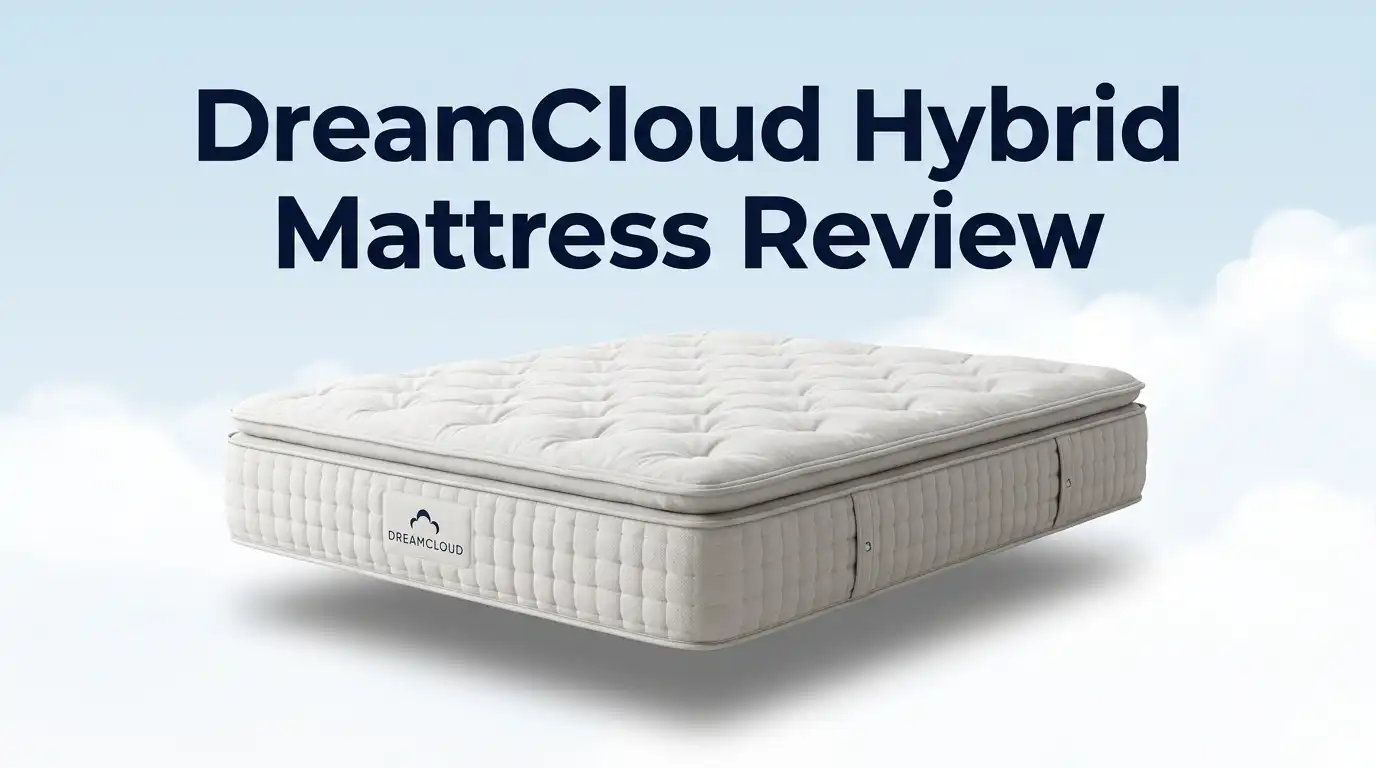
DreamCloud Hybrid Mattress Review 2026: Worth Buying?
The DreamCloud Hybrid has become one of the most talked about beds in a box, and 2026 is the year it finally got interesting.
The brand rebuilt the mattress, moved production to the United States under Ashley Sleep, and dropped the price to a level that makes shoppers look twice. A queen now sits near the $650 mark, which is roughly half of what most hybrid mattresses cost.
This review covers the unboxing smell, the firmness, the cooling, the edge support, and the places where this mattress quietly falls short. No hype, no fluff, just what you actually get for your money.
In a Nutshell:
- The price is the headline. A queen DreamCloud Classic Hybrid costs around $649, roughly 55 percent below the average hybrid price. You are getting real pocketed coils, gel memory foam, and a quilted cover for the price of many all foam beds.
- The firmness lands at medium firm, about a 6 out of 10. That makes it a safe pick for back sleepers, stomach sleepers, and most side sleepers up to 300 pounds. It is not a plush cloud, despite the name.
- Motion transfer is excellent. Testing showed about 6.79 m/s of acceleration, roughly 21 percent below average. Couples with different schedules will appreciate that.
- Pressure relief is only good, not great. The comfort layer measures 3.5 inches, which is thinner than the 4.1 inch average. Strict side sleepers with sharp hips may want more cushion.
- The off gassing is real. The smell was strong out of the box and took about seven days to fade fully. Plan on airing the room.
- The company terms are the best part. You get a 365 night trial, free shipping, free returns, and a lifetime warranty. That safety net removes most of the risk of buying online.
DreamCloud Classic Hybrid Mattress Review


Last update on 2026-10-19 / Affiliate links / Images from Amazon Product Advertising API
The DreamCloud Classic Hybrid is a 12.5 inch hybrid built with a quilted cover, gel memory foam, poly foam, and an 8 inch pocketed coil unit. It arrives in one firmness only, medium firm, which the brand aims at the widest possible group of sleepers.
The build is straightforward. A 1.5 inch quilted cover sits on top, followed by 1 inch of gel memory foam and 1 inch of firmer transition foam. Under that sit the coils and a 1 inch base foam for stability. Total weight for a queen is about 79 pounds.
What surprised me most was the support layer. At 9 inches, it runs about an inch thicker than average, and you feel that stability under your lower back. The bed keeps your spine flat instead of letting your hips sag.
The 2026 model is a genuine redesign, not a relabel. Build quality, foam cuts, and layer consistency all improved over the older imported version. This is the best DreamCloud has ever felt at the lowest price it has ever sold for.
Unboxing the DreamCloud Hybrid
The box shows up at your door, not in your bedroom, so plan for that. A queen box weighs close to 90 pounds with packaging. Two people make this easy. One person makes it a workout and a mild back risk.
The mattress is rolled, vacuum sealed, and wrapped in thick plastic. DreamCloud includes a small cutting tool in some shipments, but a box cutter works fine. Slide the roll onto your bed frame first, then cut. Cutting it on the floor means lifting an unrolling mattress, which nobody enjoys.
Once the plastic opens, the mattress puffs up fast. Mine reached about 90 percent of full height within an hour and looked completely normal by the next morning. The brand suggests up to 72 hours for full expansion.
Now the honest part. The smell was strong. It filled the bedroom within minutes and stayed noticeable for a couple of days. It took a full week before the room smelled neutral again. Open a window and run a fan.
What Is Inside the Mattress
Knowing the layers helps you predict the feel. The DreamCloud Hybrid keeps the recipe simple, and simplicity is part of why the price works.
The quilted cover is soft, stretchy, and finished with scalloped stitching that looks more expensive than it is. DreamCloud lists cooling fibers in the cover. In practice, the cover does not feel cold to the touch. Do not buy it expecting an icy surface.
Below the cover sits 1 inch of gel infused memory foam. This layer creates the gentle hug and absorbs movement. Under that, 1 inch of firmer poly foam pushes back and stops you from sinking too far.
The support base holds 8 inches of individually wrapped coils, with reinforced coils around the perimeter. A 1 inch foam base finishes the stack.
Everything here is CertiPUR US certified and fiberglass free, which matters to anyone who has read horror stories about fiberglass covers. The mattress is built in Mississippi.
DreamCloud Luxe Hybrid Mattress

Last update on 2026-10-19 / Affiliate links / Images from Amazon Product Advertising API
If the Classic feels too plain, the DreamCloud Luxe Hybrid is the step up. It measures 14 inches tall and carries a medium feel rather than medium firm, so it cushions more at the shoulders and hips.
The Luxe adds extra gel memory foam and a plusher quilted top. Side sleepers who felt the Classic was too firm usually land on this one. The added height also gives the bed a more premium look on a low platform frame.
Expect a deeper cradle and a slightly slower response. You sink in more, and you notice the mattress more when you change positions. The coil unit still keeps your spine supported, so it does not feel mushy.
Two practical notes. Deep pocket sheets are required, since 14 inches plus a mattress protector eats standard sheets alive. The Luxe also sleeps a touch warmer than the Classic because your body sits lower in the foam.
Choose the Luxe if you sleep on your side and weigh under 200 pounds. Choose the Classic if you sleep on your back or stomach.
Top 3 Alternative for DreamCloud Hybrid Mattress

Last update on 2026-10-19 / Affiliate links / Images from Amazon Product Advertising API
Nectar Premier 13 Inch Hybrid Mattress

Last update on 2026-10-18 / Affiliate links / Images from Amazon Product Advertising API
Novilla Bliss 12 Inch Hybrid Mattress

Last update on 2026-10-17 / Affiliate links / Images from Amazon Product Advertising API
Sweetnight CoolNest 16 Inch Hybrid Mattress
Firmness and Feel Explained
DreamCloud rates the Classic Hybrid as firm on its own site. Independent testing places it at a 6 out of 10, which is textbook medium firm. The truth sits between those two claims.
Here is how I would describe it. You lie down and feel a light cushion on the surface for about an inch, then the coils catch you. There is no slow sinking quicksand feeling that thick memory foam beds create.
The mattress responds quickly. Measured recovery was about 0.3 seconds for mostly recovered and 0.6 seconds for fully recovered, both faster than average. You will never feel stuck when rolling over.
Sinkage measured 2.48 inches at pressure points, slightly deeper than average. That combination of deeper sinkage with fast rebound gives the bed a balanced feel rather than a dramatic hug.
Bounce is moderate at about 9 inches of total rebound. It is enough for easy movement but not enough to feel springy like a traditional innerspring bed. Most sleepers adjust within three or four nights.
Sleeping Positions: Who It Fits
Back sleepers get the best experience here. The thicker support layer keeps your hips level with your shoulders, and the medium firm surface stops any hammock effect. My lower back felt noticeably better after two weeks compared to my old all foam bed.
Stomach sleepers also do well. The firmness prevents the midsection from dropping, which is the main cause of morning back pain in this position. Heavier stomach sleepers should still find enough pushback.
Side sleepers are the mixed group. Testing showed a max pressure reading of 0.50 PSI at the shoulder, which is comfortably in the low pressure range. Most side sleepers will be fine.
Strict side sleepers with broad shoulders or sharp hip bones may want more cushion. The 3.5 inch comfort layer simply is not thick enough to swallow those pressure points the way a plush bed does.
Combination sleepers benefit from the fast response time. Switching positions takes no effort at all.
Cooling Performance in Real Use
Cooling is where honest reviewing matters. The DreamCloud Hybrid scored 8.0 out of 10 for cooling, which is good but below the 8.6 average across tested mattresses.
Surface temperature after 15 minutes of contact measured 92.0 F, about two degrees warmer than typical. Heat dropped quickly once I got off the bed, falling 7.3 degrees in the first minute.
Here is the practical translation. You will not wake up drenched, but this is not a cooling mattress either. The coil layer keeps air moving, and the gel foam sits below the cover rather than against your skin, which helps.
The marketing mentions cooling fibers in the cover. I never felt them. The cover is soft and breathable but neutral in temperature.
If you run hot every single night, pair it with a cooling protector or breathable sheets. Hot sleepers who need real temperature control should look at a mattress with phase change fabric instead. For average sleepers, heat never became an issue.
Motion Transfer and Couples Testing
This is the strongest performance category on the mattress. Motion transfer measured 6.79 m/s of acceleration, roughly 21 percent below the average of 8.64 m/s.
In plain English, your partner can get out of bed at 5 a.m. and you will likely sleep through it. The memory foam layer absorbs energy, and the pocketed coils move independently rather than as one unit.
I tested this the unglamorous way. A glass of water placed near the edge barely rippled when I dropped onto the other side of the bed. My partner rolling over never woke me once.
One small caveat. Motion took about 0.92 seconds to fully settle, which is slower than ideal. The intensity stays low the whole time, so it rarely registers.
The mattress is also quiet. The coils never squeaked during two months of use. For couples sharing a bed, this is the single best reason to choose the DreamCloud. Different sleep schedules stop being a nightly argument.
Edge Support and Usable Surface
Edge support scored 8.9, which beats the average of 8.6. The perimeter uses reinforced coils around all four sides.
Sitting on the edge produced 3.25 inches of compression, better than the 4 inch average. That means putting on shoes in the morning feels secure rather than tippy. Nobody slides off.
Lying on the edge tells a slightly different story. Support was good but not excellent. I could sleep within a few inches of the side without feeling like I was rolling away, though the surface compressed more than the center did.
The thinner comfort layer is the reason. There simply is not enough foam above the coils to keep the edge perfectly flat under a lying body.
For smaller bedrooms or couples who use every inch of the mattress, the usable surface is generous. Sleepers over 300 pounds will notice more edge compression and should temper expectations. At this price, the edge performance is more than fair.
Pros and Cons of the DreamCloud Hybrid
Every mattress has trade offs. Here is the honest scorecard.
Pros
- Outstanding value. A queen near $649 undercuts most hybrid competitors by hundreds of dollars.
- Very low motion transfer at 6.79 m/s, which makes it excellent for couples.
- Fast response time of 0.3 seconds, so moving around never feels like work.
- Strong sitting edge support thanks to reinforced perimeter coils.
- 365 night trial, lifetime warranty, free shipping, and free returns. The risk of trying it is close to zero.
- Built in the United States, fiberglass free, and CertiPUR US certified.
- Works for back, stomach, and most side sleepers up to 300 pounds.
Cons
- Comfort layer is thin at 3.5 inches, below the 4.1 inch average.
- Pressure relief scores 8.0, under the 8.7 average for tested hybrids.
- Cooling is average at best, with surface temps about two degrees warmer than typical.
- Strong off gassing smell that lingered a full seven days.
- No zoned support, so there is no extra reinforcement under the hips.
- One firmness only on the Classic model, so plush fans must upgrade to the Luxe.
- Heavy and awkward to move, at roughly 79 pounds for a queen with no handles.
What This Mattress Does Not Do Well
Authentic reviews name the weak spots, so here they are without softening.
The foam quality is fine, not luxurious. Press into the layers and you feel serviceable materials rather than premium ones. That is exactly what a $649 hybrid should contain, but the brand markets itself as luxury, and the foams do not match that word.
The name DreamCloud suggests a soft, cloudlike surface. It is not soft. Shoppers expecting a plush hotel bed are the ones who return it.
There is no zoned support anywhere in the build. Better hybrids add firmer coils under the lumbar region. This one uses a uniform coil layer.
Durability remains the open question. The 2026 build quality looks much better than older versions, yet the mattress is new enough that long term sagging data does not exist. Customer complaints about older DreamCloud models often mentioned body impressions after a couple of years.
Customer service reviews are also mixed. Returns are free, but some buyers report slow response times during the process.
Price, Trial, and Warranty Details
Pricing runs roughly $399 for a twin, $549 for a twin XL, $579 for a full, $649 for a queen, and $849 for a king or California king. Sales move these numbers often, so check before buying.
The average hybrid mattress costs around $1,511 for a queen. DreamCloud saves you roughly $860. That gap alone explains most of the brand’s popularity.
The trial period runs 365 nights, far above the 170 night average. You get a full year of seasons to decide, which matters because mattress comfort changes with temperature and body weight.
The warranty is a limited lifetime warranty. Only about 39 percent of tested mattresses offer lifetime coverage. Read the fine print, since sagging must usually exceed a set depth to qualify.
Shipping and returns are both free. Combine that with a year long trial and the financial risk of trying this mattress is essentially nothing. That safety net is worth real money.
Who Should Buy the DreamCloud Hybrid
Buy this mattress if you want a real hybrid without spending over $1,000. That is the core case, and it is a strong one.
Back and stomach sleepers get the best fit. The medium firm surface and thick coil base keep the spine aligned without extra effort.
Couples should take this seriously. The motion isolation is genuinely better than most beds twice the price. Light sleepers with restless partners will notice the difference immediately.
Guest rooms and kids rooms are another smart use. You get durable coils and a lifetime warranty at a price that does not hurt.
Skip it if you are a dedicated side sleeper who needs deep cushioning, a hot sleeper who wakes up sweating, or someone over 300 pounds who needs reinforced zoned support. Also skip it if you cannot tolerate a week of new mattress smell.
Shoppers who want plush comfort should upgrade to the DreamCloud Luxe rather than force the Classic to be something it is not.
Final Verdict
The DreamCloud Hybrid earns a recommendation, with clear boundaries around who it suits.
Independent testing gave it an overall score of 8.66, just above the 8.55 average. That number alone is unremarkable. Pair it with a $649 queen price and the value calculation changes completely.
You are buying a competent hybrid, not a class leader. Cooling is average. Pressure relief is decent. Motion isolation and response time are genuinely excellent. Build quality improved sharply with the 2026 redesign and the move to United States manufacturing.
The 365 night trial does most of the persuading. If it fails you, send it back at no cost. Few purchases in this price range come with that much protection.
My rating: 4.3 out of 5 for value, 3.8 out of 5 for pure performance. Most sleepers who buy it keep it, and the ones who return it usually expected something softer than the name implies. Know what you are buying and you will sleep well.
Frequently Asked Questions
Is the DreamCloud Hybrid good for back pain?
Most back sleepers report improvement. The 9 inch coil support layer keeps the spine aligned and prevents hip sinkage, which is the usual cause of morning stiffness. People with shoulder pain who sleep on their side may need more cushion than the 3.5 inch comfort layer provides.
How long does the DreamCloud take to expand?
The mattress reaches most of its height within one hour. Full expansion takes up to 72 hours. You can sleep on it the first night without any problem.
Does the DreamCloud Hybrid smell?
Yes. The off gassing smell was strong out of the box and took about seven days to disappear completely. Open windows and run a fan for the first few days. The foams are CertiPUR US certified, so the odor is harmless but noticeable.
What bed frame works with the DreamCloud?
It works on platform frames, slatted bases with gaps under 4 inches, box springs, and adjustable bases. A solid foundation protects your warranty coverage.
Is the DreamCloud Hybrid too firm?
The Classic sits at medium firm, about a 6 out of 10. It is firmer than the brand name suggests. Choose the DreamCloud Luxe if you prefer a softer surface.
Does the DreamCloud contain fiberglass?
No. The mattress is fiberglass free and manufactured in the United States by Ashley Sleep.
How long does a DreamCloud mattress last?
Expect roughly seven to ten years with proper support and rotation. Rotate it every three to six months to slow body impressions.

Hi, I’m Ava Day, the founder and lead writer at Cozy Bed Vault. I’m passionate about sleep wellness and dedicated to helping people find their perfect mattress. Through honest reviews, detailed comparisons, and expert buying guides, I simplify the mattress shopping experience so you can sleep soundly every night.