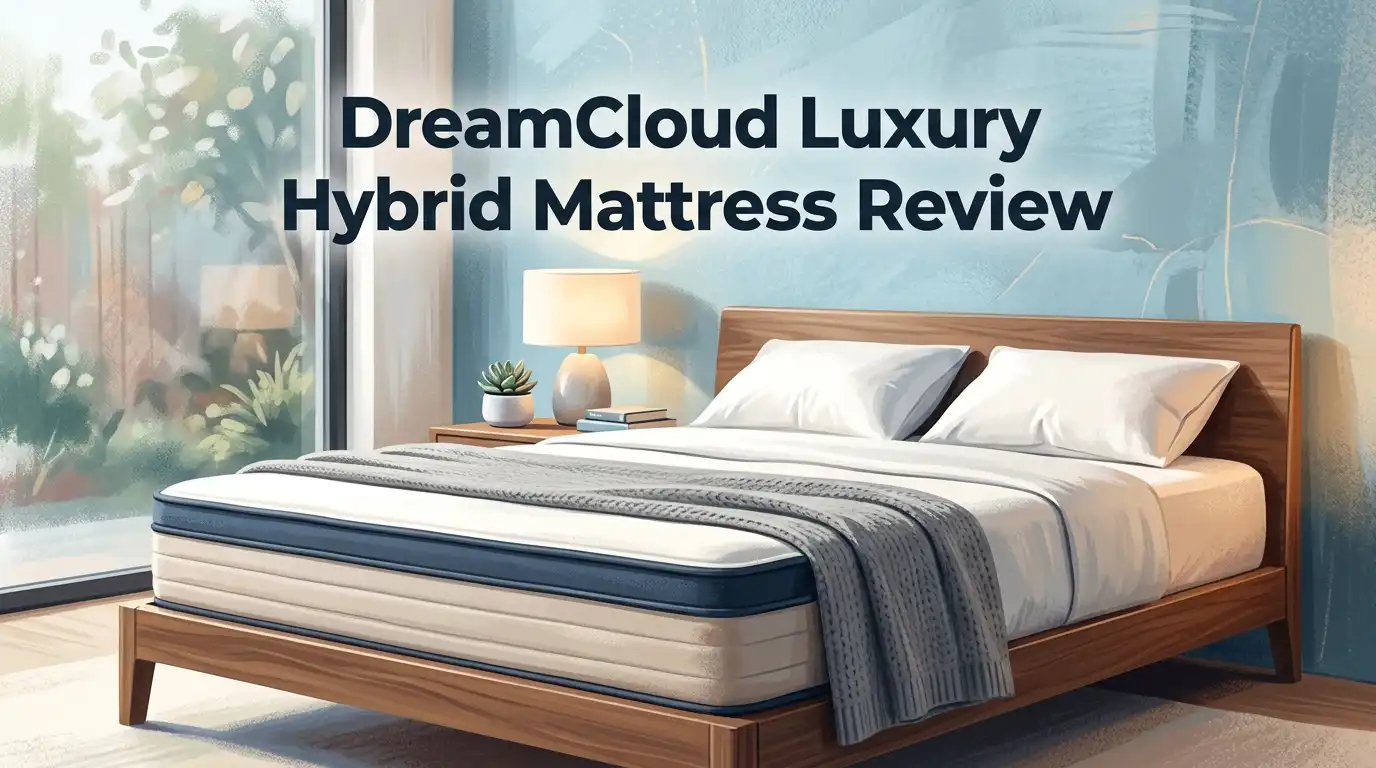
DreamCloud Luxury Hybrid Mattress Review 2026: Worth Buying?
Mattress shopping gets confusing fast. Every brand promises cloud comfort, cooling magic, and spine support.
The DreamCloud Luxury Hybrid has been one of the loudest names in the bed in a box space since 2018, and the 2026 version is a very different mattress than the one people bought five years ago.
The brand now sits under Ashley Sleep, production moved back to the United States, and the price dropped hard.
In a Nutshell:
- Firmness sits at a true medium firm, roughly 6 out of 10. Most back sleepers and stomach sleepers get solid spinal support. Strict side sleepers under 130 pounds often find it too firm at the shoulder.
- The price is the headline feature. A queen runs near $649 to $699 depending on the sale, which is less than half the average hybrid price. Value is where this mattress wins, not raw performance.
- Motion isolation is excellent. Testing showed about 21 percent less motion travel than the average hybrid. Couples with different schedules will appreciate that.
- Cooling is fine, not cold. The cover advertises cooling fibers, but the surface never feels chilly. Deep sinkage traps a little body heat, so very hot sleepers should look elsewhere.
- The comfort layer is thin at 3.5 inches. That is below the 4.1 inch average, and it limits deep pressure relief for heavier hips and shoulders.
- DreamCloud offers a 365 night trial and a lifetime warranty with free shipping and free returns. Those terms are generous on paper, though some buyers report slow customer service when claims get filed.
What Is the DreamCloud Luxury Hybrid Mattress?


Last update on 2026-10-16 / Affiliate links / Images from Amazon Product Advertising API
The DreamCloud Luxury Hybrid is a 12.5 inch mattress that mixes foam comfort layers with pocketed coils. DreamCloud launched in 2018 as the premium sister brand to Nectar, and both now belong to the same parent group. The 2026 model, sold as the DreamCloud Classic Hybrid, replaced the older 14 inch version in 2025.
You get one firmness option only. That keeps things simple but removes choice. The mattress ships compressed in a box, arrives in a few days, and expands on its own.
DreamCloud markets this bed as hotel quality sleep at a direct to consumer price. The marketing language is generous, but the core promise holds up: a coil supported hybrid with a quilted pillow top feel, sold for the price of a basic foam bed.
Unboxing Experience: What the First Night Felt Like
The box arrived on a pallet at my front door. The queen weighs about 79 pounds, so grab a second person. There are no carry handles, which is a genuine design miss. Dragging an 79 pound vacuum sealed roll up a staircase alone is not fun.
Cutting the plastic takes about thirty seconds. The mattress puffs up fast, reaching most of its height inside an hour and full shape in roughly six hours.
Then comes the smell. The off gassing was strong, stronger than I expected, and the odor lingered around seven days in a closed bedroom. Open a window and run a fan for the first three nights. Night one felt stiff and plasticky. By night four the surface softened and the quilted cover started feeling like a real pillow top.
Inside the Layers: How It Is Built
The build is straightforward and easy to understand. From top to bottom you get a 1.5 inch quilted CloudQuilt cover with poly foam and cooling fibers, a 1 inch gel memory foam layer, a 1 inch firmer poly foam transition layer, 8 inches of individually wrapped pocketed coils, and a 1 inch support foam base.
That gives a 3.5 inch comfort section and a 9 inch support section. The support layer is thicker than average, which explains the strong spinal support.
Coils around the perimeter are reinforced for edge stability. The foams carry CertiPUR US certification, and the mattress is fiberglass free, which matters to anyone who has read horror stories about torn mattress covers.
Build quality in the 2025 redesign looks noticeably cleaner than the older import version. Layer cuts are even and the glue lines are tidy.
Top 3 Alternative for DreamCloud Luxury Hybrid Mattress

Last update on 2026-10-16 / Affiliate links / Images from Amazon Product Advertising API
Nectar Premier 13 Inch Hybrid Mattress

Last update on 2026-10-16 / Affiliate links / Images from Amazon Product Advertising API
Sweetnight 12 Inch Plush Pillow Top Hybrid Mattress

Last update on 2026-10-17 / Affiliate links / Images from Amazon Product Advertising API
Linenspa 12 Inch Hybrid Mattress Medium Plush
Firmness Rating and How It Actually Feels
DreamCloud calls this mattress firm. Independent testing lands it at medium firm, about a 6 out of 10. Both descriptions are partly right, and that gap confuses buyers.
Here is the honest feel. The quilted cover gives a soft first impression. Push past that half inch and the foam gets dense quickly. Coils then take over and push back.
You sink in about 2.48 inches at the hips, which is deeper than the category average. So the bed feels supportive underneath and gently cradling on top at the same time.
Response time is fast, around 0.3 seconds to mostly recover shape. You never feel stuck or swallowed by this mattress. Rolling over is easy, which helps restless sleepers and anyone with mobility concerns.
Best Sleeping Positions for This Mattress
Back sleepers get the best experience. Hips stay level, the lumbar gap fills nicely, and the coils keep the spine neutral. Stomach sleepers do well too since the firmer surface stops the hips from dipping.
Side sleepers are the mixed group. Average weight side sleepers between 150 and 250 pounds generally sleep fine. Lightweight side sleepers often report shoulder pressure because they cannot compress the foam enough to let the shoulder settle.
Combination sleepers benefit from the quick response and low surface friction.
Weight wise, the mattress handles sleepers up to about 300 pounds comfortably. Above that range, the thin comfort layer starts bottoming out and the coils become the dominant feel. Couples with a large weight difference should expect compromise here.
Cooling Performance and Heat Buildup
Cooling is where marketing and reality separate. DreamCloud advertises cooling fibers in the cover and gel infused memory foam. The cover does not feel cool to the touch at all.
Temperature testing showed a peak surface reading around 92 degrees Fahrenheit, roughly two degrees warmer than the average mattress tested. Heat then dropped quickly once the sleeper moved off.
So the bed is temperature neutral rather than cooling. Pocketed coils keep air moving through the core, which prevents the swampy feeling that pure foam beds cause.
The deeper sinkage works against you though. More body contact means more trapped warmth around the hips and shoulders.
If you wake up sweating every night, add breathable cotton or bamboo sheets and skip the quilted mattress protector. Night sweats sufferers should consider a latex hybrid instead.
Motion Isolation and Couples Performance
This is the strongest test result on the whole mattress. Motion travel measured 6.79 meters per second against an 8.64 average, which means roughly 21 percent less disturbance when your partner moves.
The 1 inch memory foam layer soaks up energy before it reaches the coils. Individually wrapped coils then move alone instead of as a unit.
In practice, you can get out of bed without waking a light sleeping partner. Pets jumping on the bed barely register either.
The mattress is also quiet. No squeaks, no creaks, even after months of use.
One small negative: motion takes about 0.92 seconds to settle fully, which is slower than ideal. You feel a soft lingering wobble rather than a sharp jolt. Most sleepers will never notice that.
Edge Support and Usable Surface
Edge support beats expectations for this price. Sitting on the perimeter produced 3.25 inches of compression, better than the 4 inch average.
Reinforced coils run the full perimeter, so putting on shoes at the edge feels stable instead of sliding.
Lying directly on the edge works well in all three positions. Couples who sleep spread out get close to the full width of the mattress.
The lying edge is still the weaker half of the equation. The thin comfort layer gives slightly less cushioning right at the border, so you feel the coil structure more there.
For a bed under $700, this level of edge performance is genuinely impressive. Older DreamCloud versions were noticeably worse in this area.
Pressure Relief and Back Pain Relief
Pressure mapping showed a maximum reading of 0.50 PSI for side sleeping, well inside the low pressure range. No sharp hot spots appeared at the shoulders, hips, or knees.
That said, pressure relief scored 8.0 against an 8.7 average. The reason is simple: only 3.5 inches of comfort foam sits above the coils.
People with chronic hip bursitis or shoulder injuries will likely want more cushion than this mattress provides.
For general lower back ache, the story is better. The firm support layer keeps the lumbar spine aligned, and many owners report less morning stiffness after switching from a sagging innerspring.
There is no zoned support in this mattress, meaning the firmness stays identical from head to toe. Premium beds vary firmness by body region, and that difference shows.
Pros and Cons of the DreamCloud Luxury Hybrid
Pros
- Excellent motion isolation, about 21 percent better than average, which suits couples and restless sleepers
- Strong price to performance ratio with a queen under $700 during most sale periods
- Reinforced perimeter coils deliver stable edge support for sitting and sleeping
- Fast 0.3 second response time means easy movement and no stuck feeling
- 365 night sleep trial, lifetime limited warranty, free shipping, and free returns
- Fiberglass free construction with CertiPUR US certified foams
- Thicker than average 9 inch support core handles sleepers up to 300 pounds
Cons
- Comfort layer measures only 3.5 inches, below the 4.1 inch category average
- Cooling is average at best despite heavy cooling marketing language
- Strong off gassing smell lasting around seven days
- Single firmness option with no soft or extra firm choice
- No handles on a 79 pound queen, so setup needs two people
- No zoned support, so firmness never changes along the body
- Lightweight side sleepers frequently find the shoulder area too firm
- Customer service complaints appear often in warranty and return threads
What the DreamCloud Luxury Hybrid Does Not Do Well
Honest reviews name the failures, so here they are. This mattress does not sleep cold. Anyone searching for a cooling bed will feel let down by the cover.
It does not deliver plush pressure relief. Side sleepers with sharp hip and shoulder angles need deeper foam than 3.5 inches.
It does not accommodate different body types with one purchase. A 110 pound side sleeper and a 240 pound back sleeper cannot both be happy on a single medium firm surface.
Customer service is the most common complaint online. Buyers describe long waits, repeated document requests, and difficulty completing the advertised 365 night return. Reports on review platforms and the Better Business Bureau follow that same pattern.
Finally, long term durability remains unproven. The 2025 redesign is too new for ten year data.
Pricing, Sizes, and Value in 2026
Current pricing runs roughly $399 for a twin, $549 for a twin XL, $579 for a full, $649 for a queen, and $849 for king and California king. Amazon listings sit close to those numbers, sometimes a little higher.
Compared with the $1,500 average hybrid price, this is a serious discount. You save roughly $860 on a queen.
DreamCloud runs sales almost continuously, so paying full price is rarely necessary. Watch holiday weekends for bundle offers that include pillows and sheets.
The value calculation is clear: you accept average cooling and average pressure relief in exchange for paying less than half the usual hybrid price. For guest rooms, teen bedrooms, rental properties, and first apartments, that trade makes real sense.
Trial Period, Warranty, and Return Reality
On paper the policy is best in class. You get 365 nights to test the bed, a lifetime limited warranty, free delivery, and free returns.
Most brands offer 100 nights and a ten year warranty, so DreamCloud looks generous.
Read the fine print though. Warranty claims require a sag of at least one inch and proof that the mattress sat on proper support. Keep your bed frame receipt and photograph your setup.
Several owners describe return requests dragging on for weeks. Document every email, note the names of representatives, and pay by credit card so you keep a dispute option.
Lifetime coverage also means limited coverage, with prorated replacement costs after the first decade. Treat the policy as good, not bulletproof.
Who Should Buy It and Who Should Skip It
Buy it if you sleep on your back or stomach, weigh between 130 and 300 pounds, share a bed with a restless partner, and want a real coil hybrid under $700. Value hunters get the most from this purchase.
Buy it if you need a reliable guest room bed that handles mixed sleepers without complaints.
Skip it if you sleep hot, since cooling is the weakest measured category. Skip it if you are a lightweight side sleeper who needs shoulder cushioning.
Skip it if you want zoned lumbar support or multiple firmness choices.
Skip it if slow customer service would ruin the experience for you. Shoppers who value smooth support handling should pay more for a brand with stronger service records.
Final Verdict: Is the DreamCloud Worth It in 2026?
The DreamCloud Luxury Hybrid earns a solid recommendation with clear limits. Performance scores land just above average across ten categories, and the price sits far below average. That combination makes it one of the best value hybrids available right now.
It is not a luxury mattress despite the name. It is a well built, honestly supportive, budget friendly hybrid that does most things well and nothing exceptionally.
I would rate it 8.5 out of 10 for value and 7.5 out of 10 for pure comfort performance.
Order it with realistic expectations, plan for a week of off gassing, and use the trial period seriously. If medium firm support at a low price describes your need, this mattress delivers.
Frequently Asked Questions
Is the DreamCloud Luxury Hybrid good for back pain?
Yes for general lower back ache. The 9 inch coil core keeps the spine aligned and prevents hip sinkage. People with specific hip or shoulder joint conditions may need a softer mattress with deeper foam.
How long does the DreamCloud take to expand?
The mattress reaches most of its height within one hour and full shape in about six hours. Allow 24 to 48 hours before judging the feel, and air the room out for the first week.
Does the DreamCloud mattress sleep hot?
It sleeps temperature neutral rather than cool. Coils allow airflow through the core, but the deeper sinkage holds some body heat. Hot sleepers should pair it with breathable sheets or choose a dedicated cooling model.
Does the DreamCloud need a box spring?
No. Any solid or slatted platform works, with slats no wider than three inches apart. It also works on adjustable bases and on the floor, though floor placement can restrict airflow.
Is DreamCloud the same company as Nectar?
Yes, both brands share the same parent company and now fall under Ashley Sleep. DreamCloud focuses on hybrid coil models while Nectar leans toward memory foam feel.
How firm is the DreamCloud Luxury Hybrid really?
Independent testing places it at medium firm, around 6 out of 10. DreamCloud describes it as firm, which overstates the surface. Expect a soft quilted top over a firm supportive core.
Can you return the DreamCloud after the trial starts?
Yes, after a required 30 night break in period and within the 365 night window. Returns are advertised as free, though some buyers report delays and extra paperwork during the process.

Hi, I’m Ava Day, the founder and lead writer at Cozy Bed Vault. I’m passionate about sleep wellness and dedicated to helping people find their perfect mattress. Through honest reviews, detailed comparisons, and expert buying guides, I simplify the mattress shopping experience so you can sleep soundly every night.