Can You Use Any Mattress With an Adjustable Base?
You just bought an adjustable base or you are thinking about getting one. The first question that pops into your mind is probably this: can you use any mattress with an adjustable base? The short answer is no.
Not every mattress will work safely or comfortably on an adjustable frame. Some mattresses bend and flex with ease, while others crack, lose shape, or even void your warranty. Picking the wrong mattress can cost you hundreds of dollars in damage and leave you sleeping worse than before.
This guide breaks down exactly which mattresses work, which ones do not, and how to check your current mattress before you pair it with an adjustable base. By the end, you will know how to make the right choice and avoid costly mistakes.
Key Takeaways
- Not every mattress is safe to use on an adjustable base. Traditional innerspring mattresses with connected coil systems are too rigid to flex with the base. They can suffer permanent damage and may void your warranty. Memory foam, latex, and certain hybrid mattresses are the best options because they bend smoothly without losing their structure.
- Mattress thickness plays a major role in compatibility. The ideal thickness for an adjustable base is between 8 and 14 inches. Anything thicker may resist bending, limit the base’s range of motion, or exceed its weight capacity. A mattress that is too thin may lack support and wear out faster under repeated flexing.
- Always check your mattress warranty before pairing it with an adjustable base. Some manufacturers clearly state that using their mattress on an adjustable frame will void the warranty. Look for labels or product descriptions that specifically mention “adjustable base compatible” or “flexible foundation friendly.”
- You can test your existing mattress at home. Lift one end of your mattress and see if it bends smoothly without resistance. If it folds easily and springs back to its flat shape, it will likely work on an adjustable base. If it feels stiff or makes cracking sounds, it is not a good fit.
- Hybrid mattresses can work, but only if they use individually pocketed coils. Hybrids with interconnected coil systems do not flex well and may get damaged. Always confirm the coil type before placing a hybrid mattress on your adjustable frame.
- A compatible mattress protects both your sleep quality and your investment. The wrong pairing can shorten the lifespan of both the mattress and the adjustable base, leading to sagging, motor strain, and uneven support.
Why Not All Mattresses Work on Adjustable Bases
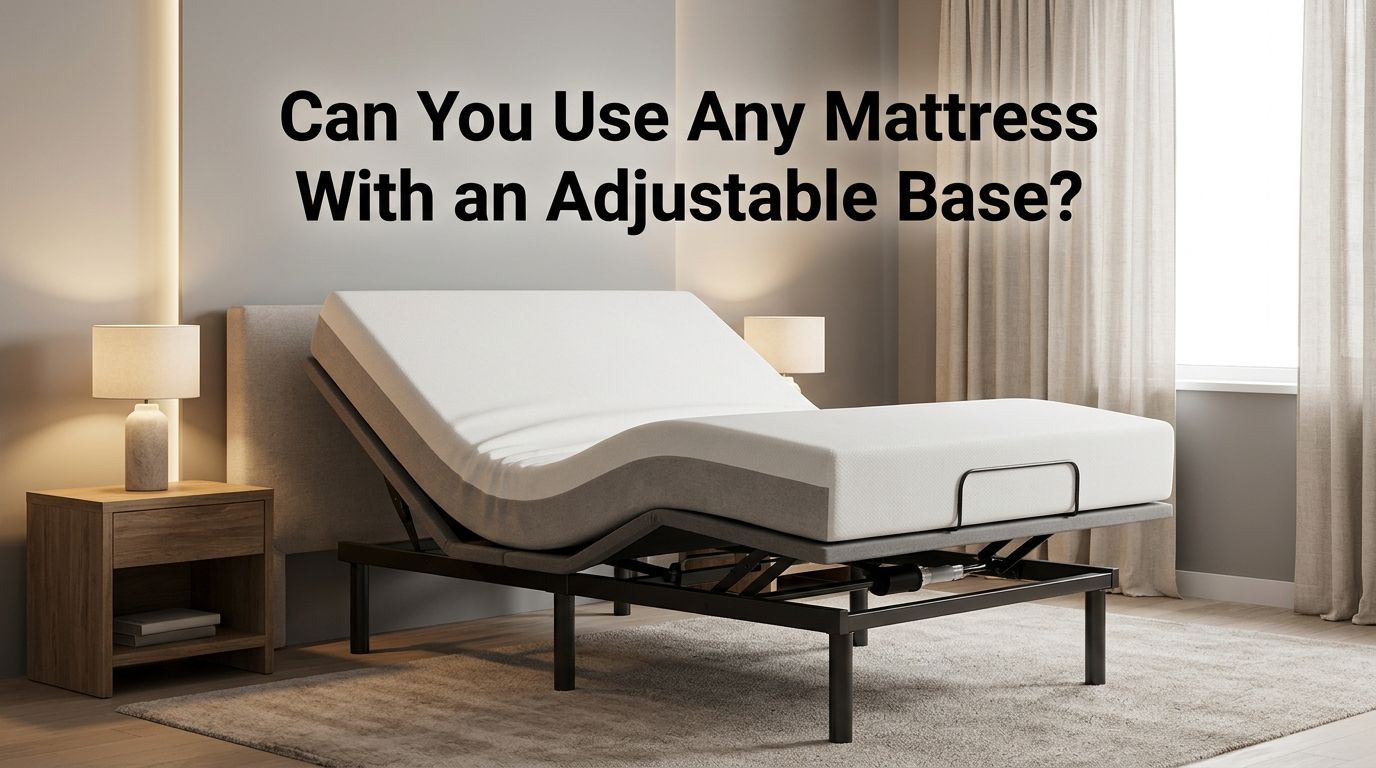
Adjustable bases move. They raise your head, elevate your feet, and bend at various angles. A mattress placed on this type of base must flex along with it. Rigid mattresses resist this bending, and that resistance creates stress on the mattress materials and the base motor.
Traditional innerspring mattresses use interconnected coil systems. These coils lock together, forming a stiff structure that does not want to bend. Forcing them to flex can warp the springs, damage the comfort layers, and put extra strain on the adjustable base motor.
Mattresses made from foam or latex, on the other hand, are naturally flexible. They conform to the changing angles of the base without fighting back. This is why material type is the single most important factor in determining compatibility.
Memory Foam Mattresses and Adjustable Bases
Memory foam is one of the best mattress types for adjustable bases. The foam is soft, pliable, and moves with the base as it shifts positions. It bends at the head and foot without cracking or losing its original shape.
Most memory foam mattresses between 8 and 12 inches thick perform well on adjustable frames. They contour to your body and to the base angles at the same time, giving you consistent pressure relief in every position.
Pros: Excellent flexibility, no noise during movement, strong pressure relief, and widely available in adjustable base compatible designs. Cons: Some memory foam mattresses retain heat, which can be uncomfortable for hot sleepers. Very dense memory foam may also resist bending slightly more than softer versions.
Latex Mattresses and Adjustable Bases
Latex mattresses are another strong choice. Both natural and synthetic latex have excellent flexibility and bounce. Latex bends easily, returns to its flat shape quickly, and holds up well under repeated flexing over time.
Many sleep experts consider latex to be one of the most adjustable base friendly materials available. It is durable, responsive, and does not develop permanent impressions as quickly as some foam types.
Pros: Naturally cooling, very durable, highly responsive, and resistant to sagging. Latex also tends to be hypoallergenic. Cons: Latex mattresses are often heavier and more expensive than memory foam options. The added weight could push some adjustable bases closer to their maximum capacity.
Hybrid Mattresses and Adjustable Bases
Hybrid mattresses combine foam or latex layers on top with a coil support system underneath. They can work on adjustable bases, but only if the coils are individually pocketed. Pocketed coils move independently, which allows the mattress to bend smoothly with the base.
Hybrids with interconnected or Bonnell coil systems are a poor match. These coils lock together and resist bending, much like traditional innerspring mattresses. Before placing any hybrid on your adjustable frame, check the product specifications and confirm the coil type.
Pros: Good balance of support and comfort, better airflow than all foam options, and a familiar “bouncy” feel. Cons: Not all hybrids are compatible. Thicker or heavier hybrids may limit the base’s range of motion. You must verify the coil construction before use.
Innerspring Mattresses and Adjustable Bases
Traditional innerspring mattresses are generally not recommended for adjustable bases. The interconnected coil systems in most innerspring designs create a rigid structure. This rigidity prevents the mattress from bending properly with the base.
Forcing an innerspring mattress to flex can damage the coils, tear the fabric cover, and create uncomfortable lumps or uneven support areas. It can also strain the adjustable base motor and shorten its lifespan.
Pros: Innerspring mattresses are affordable and widely available. Cons: Poor flexibility, high risk of damage on an adjustable base, potential warranty voiding, and uneven support during incline positions. If you own a traditional innerspring mattress, it is best to replace it before using an adjustable base.
How Mattress Thickness Affects Compatibility
The thickness of your mattress directly impacts how well it works on an adjustable base. The recommended range is 8 to 14 inches. Mattresses in this range bend properly without limiting the base’s movement.
A mattress thicker than 14 inches may struggle to conform to steep angles. The extra material resists bending, which reduces the effective range of the base. It can also exceed the weight limit of some adjustable frames.
On the other end, a mattress thinner than 8 inches may not offer enough support or cushioning. It could wear out faster because it absorbs more stress during repeated flexing. Aim for a medium thickness that balances comfort, flexibility, and durability.
How to Check If Your Current Mattress Is Compatible
You do not always need to buy a new mattress. There are simple ways to test your existing one at home. Start by lifting one end of the mattress off the floor or bed frame. Bend it gently at a 30 to 45 degree angle.
If the mattress flexes smoothly and returns to its flat shape without resistance, it is likely compatible. If it feels stiff, makes cracking or popping sounds, or does not want to bend, it will not work well on an adjustable base.
Next, check the manufacturer’s label or product page for your mattress. Look for terms like “adjustable base compatible,” “flexible foundation,” or “works with power bases.” Also review your warranty terms. Some warranties specifically exclude use on adjustable frames.
Warranty Concerns You Should Know About
Using the wrong mattress on an adjustable base can void your mattress warranty. Many manufacturers include specific language in their warranty terms about approved foundations. If your mattress is not listed as adjustable base compatible, any damage caused by the base may not be covered.
This can be a costly mistake. A voided warranty means you pay out of pocket for sagging, material breakdown, or structural damage. Always read the fine print before making the switch.
Some brands fully support adjustable base use and confirm this on their warranty cards. Others are more restrictive. If you are unsure, contact the mattress manufacturer directly. Ask them whether your specific model is approved for use on an adjustable frame. Keep any written confirmation for your records.
Step by Step Guide to Pairing Your Mattress With an Adjustable Base
Follow these steps to make sure your mattress and adjustable base work well together.
Step 1: Identify your mattress type. Determine if it is memory foam, latex, hybrid, or innerspring. Memory foam and latex are the safest choices.
Step 2: Measure your mattress thickness. Confirm it falls within the 8 to 14 inch range for best results.
Step 3: Check the manufacturer’s compatibility notes. Look at the product label, website, or warranty card for adjustable base approval.
Step 4: Perform the bend test at home. Lift one end and check for smooth flexing without stiffness or cracking.
Step 5: Place the mattress on the base and test all positions. Raise the head and foot sections to their maximum angles. Look for gaps between the mattress and base, resistance to bending, or any unusual sounds.
Step 6: Sleep on it for a few nights. Pay attention to comfort, support, and whether the mattress stays in place during movement.
Common Mistakes to Avoid
One of the biggest mistakes people make is assuming all mattresses work on adjustable bases. This assumption leads to damaged mattresses, voided warranties, and poor sleep quality.
Another common error is ignoring weight limits. Every adjustable base has a maximum weight capacity that includes both the mattress and the sleeper. Heavy mattresses like thick latex or oversized hybrids can push you close to or over that limit, which strains the motor and shortens the base’s life.
People also forget to secure the mattress. Adjustable bases move, and mattresses can slide during position changes. Use a non slip mat or retainer bars if your base includes them. Failing to secure the mattress leads to misalignment and uncomfortable sleep positions.
Do You Need a Special Mattress for an Adjustable Base?
You do not need a mattress marketed specifically as “adjustable base compatible.” You need a mattress that is flexible, the right thickness, and made from materials that bend without damage. Many standard memory foam and latex mattresses meet these requirements even if they do not carry a special label.
That said, mattresses designed and tested for adjustable bases often perform better over time. They are built to handle repeated flexing without breaking down. The foam densities, coil types, and cover materials are chosen with movement in mind.
If you are buying a new mattress and you know you will use it on an adjustable base, look for one that explicitly states compatibility. This gives you peace of mind and keeps your warranty intact. But if your current mattress passes the bend test and your warranty allows it, there is no need to replace it right away.
Tips for Getting the Best Performance From Your Setup
Once you have a compatible mattress on your adjustable base, a few habits will help you get the most from both. Rotate your mattress every three to four months. Adjustable bases flex the same areas repeatedly, and rotation helps distribute wear evenly.
Avoid leaving your base in an elevated position for extended periods when you are not in bed. This can create semi permanent bends in the mattress over time. Return the base to a flat position when you get up in the morning.
Keep the base clean and inspect the mechanical parts periodically. Dust and debris can affect motor performance. Also make sure the mattress stays centered on the base. A mattress that shifts to one side receives uneven stress and wears out faster.
How Long Will a Mattress Last on an Adjustable Base?
A compatible mattress used on an adjustable base can last just as long as one used on a flat foundation. Most quality memory foam and latex mattresses last between 7 and 10 years. Hybrids with pocketed coils also fall in this range.
The key factor is compatibility. A mattress that flexes easily and is built for movement will hold up well. A mattress that is forced to bend against its design will break down much faster, sometimes within just a year or two.
Regular maintenance also extends mattress life. Rotating, using a mattress protector, and keeping the base in good working order all help. If you notice sagging, lumps, or reduced support before the expected lifespan, it may be a sign that your mattress and base are not a good match.
Frequently Asked Questions
Can I use a pillow top mattress on an adjustable base?
Some pillow top mattresses work on adjustable bases, but many do not flex well. The extra padding layer can bunch up or shift during movement. Check the manufacturer’s guidelines before placing a pillow top on your adjustable frame. If the mattress is foam based with a pillow top sewn in, it may perform better than one with a separately attached topper.
Will an adjustable base damage my mattress?
An adjustable base will not damage a compatible mattress. Memory foam, latex, and hybrids with pocketed coils are built to handle flexing. However, using an incompatible mattress like a traditional innerspring can lead to coil warping, cover tearing, and uneven support. Always confirm compatibility before pairing.
Can I use a mattress topper on an adjustable base?
Yes, you can use a mattress topper on an adjustable base. Choose a topper made from memory foam or latex, as these materials flex easily. Avoid thick or rigid toppers that could restrict movement. A non slip pad between the mattress and topper helps keep everything in place during adjustments.
What happens if my mattress is too thick for an adjustable base?
A mattress that is too thick may not bend properly at the head and foot sections. It can limit the range of motion, reduce the effectiveness of the adjustable features, and put extra strain on the base motor. Stick to the recommended 8 to 14 inch thickness range for the best results.
Do I need to buy the same brand mattress as my adjustable base?
No. You do not need to match brands. Most adjustable bases work with any compatible mattress regardless of the manufacturer. The important factors are mattress type, thickness, flexibility, and weight. Check both the mattress and base specifications to confirm they work together.
How do I stop my mattress from sliding on an adjustable base?
Use non slip pads or gripper mats between the mattress and the base surface. Many adjustable bases come with retainer bars or straps that hold the mattress in place. You can also purchase aftermarket non slip solutions. A mattress that fits the base dimensions precisely will also slide less during movement.

Hi, I’m Ava Day, the founder and lead writer at Cozy Bed Vault. I’m passionate about sleep wellness and dedicated to helping people find their perfect mattress. Through honest reviews, detailed comparisons, and expert buying guides, I simplify the mattress shopping experience so you can sleep soundly every night.