Can a Mattress Topper Fix a Bad Mattress? A Complete Guide
You toss and turn every night. Your back aches every morning. You already know your mattress is the problem. But a brand new mattress costs hundreds or even thousands of dollars. So you start wondering: can a mattress topper fix a bad mattress?
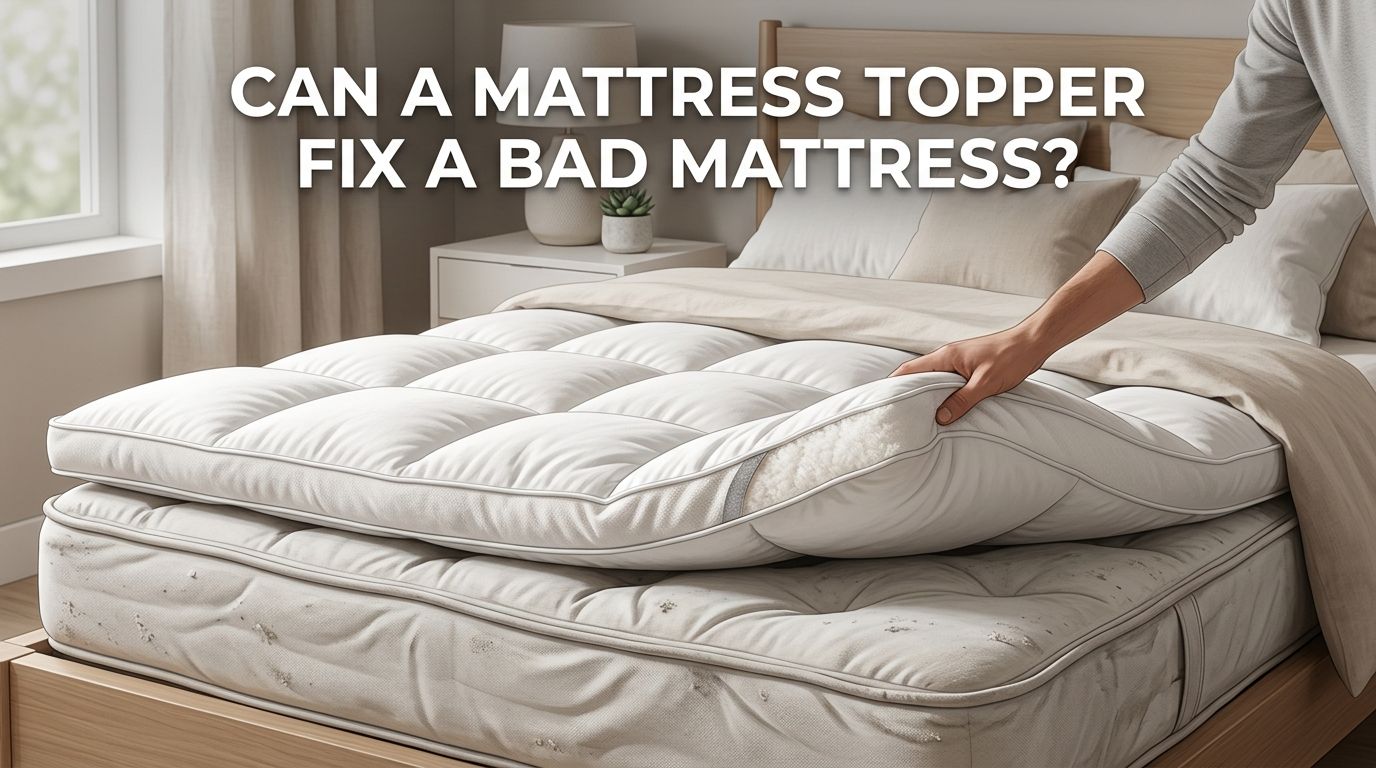
The honest answer is both yes and no. A mattress topper can solve certain comfort problems, but it cannot repair a mattress that is structurally broken. The key is understanding what your mattress actually needs and whether a topper is the right fix for your situation.
This guide breaks down exactly when a topper works, when it does not, what type you should choose, and how to get the most out of your purchase. By the end, you will know whether a topper can save your sleep or whether it is time to invest in something new.
In a Nutshell
- A mattress topper can improve comfort on a mattress that is too firm, slightly worn, or lacks a soft surface layer. It adds cushioning and pressure relief without the cost of a full mattress replacement. This is the best use case for a topper and where most people see real results.
- A topper cannot fix deep sagging, broken springs, or severe structural damage. If your mattress dips more than 1.5 inches in the center or has visible lumps and coils poking through, a topper will simply sink into those same problem areas. The topper conforms to the surface beneath it, so a damaged base creates a damaged sleeping surface.
- Choosing the right type of topper matters significantly. Memory foam, latex, down, and polyfoam toppers each solve different problems. Memory foam contours to your body and relieves pressure points. Latex offers bounce, support, and natural cooling. Down provides a plush, soft feel but minimal support.
- Thickness plays a major role in how much improvement you feel. A 2 inch topper adds a mild comfort boost. A 3 to 4 inch topper can mask minor sags and transform the feel of a too firm mattress. Thicker is generally better for aging mattresses, but only if the base is still structurally sound.
- A mattress topper is a temporary solution, not a permanent one. Even a high quality topper lasts about 3 to 5 years. It buys you time, but it does not restart the clock on your mattress.
- Pairing a topper with other fixes can multiply your results. Using a plywood board under the mattress, rotating the mattress regularly, and choosing the right topper thickness together can create a noticeably better sleep surface at a fraction of new mattress costs.
What a Mattress Topper Actually Does
A mattress topper is a separate layer of cushioning that sits on top of your existing mattress. It changes the feel of the sleeping surface without replacing the mattress underneath. Most toppers range from 2 to 4 inches thick.
Toppers work by creating a new comfort layer. If your mattress feels too firm, a soft topper adds pressure relief. If the surface has become flat and uncomfortable after years of use, a topper restores that “new mattress” feel on top.
The topper does not change the support structure of your mattress. It does not fix springs, realign foam cores, or fill in deep sags. Think of it as adding a new roof to a house. If the foundation is cracked, the new roof will not stop the house from leaning.
When a Mattress Topper Can Fix the Problem
There are several situations where a mattress topper is the perfect solution. If your mattress is too firm and causes pressure pain at the hips and shoulders, a soft memory foam or latex topper can relieve that discomfort immediately.
A topper also helps if your mattress is relatively new but just does not match your comfort preference. Some people buy a firm mattress for back support and later realize they need a softer sleeping surface. A topper bridges that gap.
Mild wear and tear is another good candidate for a topper fix. If the mattress has minor body impressions less than 1.5 inches deep, a thick topper can smooth out the surface and extend the bed’s usable life by a few more years.
Pros: Cost effective, easy to install, available in many materials, no heavy lifting required.
Cons: Does not address structural problems, adds height to the bed, may shift during the night without a fitted sheet or strap.
When a Mattress Topper Will Not Help
A topper will not rescue a mattress that has deep sags, broken coils, or large visible lumps. If you can see a noticeable dip in the middle of your bed, the topper will just sink into that dip along with you. You end up sleeping in the same uncomfortable position.
Mattresses older than 8 to 10 years often fall into this category. The internal support layers have broken down beyond what any surface layer can fix. Springs lose tension. Foam cores collapse permanently.
If you wake up with back pain every morning and your mattress visibly slopes or hammocks, a topper is not the answer. You need a new mattress. Spending money on a topper at this stage only delays the inevitable and wastes your budget.
Memory Foam Toppers: Best for Pressure Relief
Memory foam is the most popular mattress topper material. It molds to your body shape and redistributes weight evenly across the sleeping surface. This makes it ideal for side sleepers and anyone with joint pain.
A 3 inch memory foam topper can dramatically change the feel of a firm mattress. It absorbs pressure at the shoulders, hips, and knees. Many people report reduced tossing and turning after adding a memory foam topper.
Pros: Excellent pressure relief, widely available, good motion isolation for couples, available in multiple thickness options.
Cons: Retains heat and can sleep warm, may have an initial chemical odor, slow response time can make it harder to change positions, not ideal for hot sleepers.
Latex Toppers: Best for Support and Cooling
Latex toppers offer a different feel than memory foam. They are bouncy, responsive, and naturally breathable. Natural latex comes from rubber trees and tends to sleep cooler than memory foam.
Latex is a strong choice if you want both comfort and support. It does not let you sink in as deeply as memory foam. This makes it a better option for back and stomach sleepers who need a firmer but still cushioned surface.
Latex toppers also last longer than most alternatives. A quality natural latex topper can hold its shape and performance for 5 years or more, which makes it a good long term investment.
Pros: Sleeps cool, durable, responsive bounce, supports spinal alignment, hypoallergenic.
Cons: More expensive than memory foam, heavier to move and install, limited thickness options in some brands, may feel too firm for some side sleepers.
Down and Down Alternative Toppers: Best for Softness
Down toppers are filled with duck or goose feathers. They provide a luxuriously soft, cloud like sleeping experience. Down alternative toppers use synthetic fibers to mimic this feel at a lower price.
These toppers are best for people who want a plush surface without much structural support. They work well on a mattress that is fundamentally supportive but feels too hard on the surface.
However, down toppers flatten over time and need regular fluffing. They do not provide much help for sagging or worn out mattresses. They also offer almost no pressure point relief compared to foam options.
Pros: Very soft and comfortable, lightweight, good temperature regulation with natural down, machine washable in many cases.
Cons: Flatten quickly, minimal support, not suitable for sagging mattresses, natural down can trigger allergies, require frequent fluffing and maintenance.
How to Choose the Right Topper Thickness
Thickness is one of the most important factors in choosing a mattress topper. A 2 inch topper adds a subtle comfort boost and works best on a mattress that is nearly fine but just a bit too firm.
A 3 inch topper provides a noticeable change in feel and can mask very minor body impressions. This is the most popular thickness for people trying to extend the life of an aging mattress.
A 4 inch topper offers the most dramatic transformation. It can make a firm mattress feel medium soft and can bridge small dips in the surface. However, it also adds significant height to your bed, which may require deeper fitted sheets.
If your mattress sags more than 1.5 inches, even a 4 inch topper will not fully compensate. The topper will conform to the sag and you will still feel the dip beneath you.
Other Ways to Improve a Bad Mattress Without Replacing It
A mattress topper is not your only option. Placing a sheet of plywood between the mattress and the bed frame can add firmness and reduce sagging. This is especially helpful for mattresses on slatted bed frames with wide gaps.
Rotating your mattress 180 degrees every few months distributes wear more evenly. If your mattress is double sided, flipping it can also help expose a less worn surface.
Adjusting your bed frame or foundation can also make a difference. A weak or broken bed frame causes mattresses to sag prematurely. Make sure the slats are no more than 3 inches apart and that the center support is intact.
Using a mattress pad with extra fill provides a thin layer of additional cushioning. While not as effective as a topper, it can improve comfort on a mattress that is only slightly past its best days.
Step by Step Guide to Using a Topper on a Bad Mattress
Step 1: Assess your mattress. Press down in the center and along the edges. If the mattress dips more than 1.5 inches and does not bounce back, it may be beyond topper territory.
Step 2: Identify your problem. Is the mattress too firm? Too soft? Lumpy on the surface? Your answer determines the right topper material and thickness.
Step 3: Choose your topper type. Pick memory foam for pressure relief, latex for support and cooling, or down for softness.
Step 4: Select the right thickness. Go with 2 inches for a mild adjustment, 3 inches for moderate improvement, or 4 inches for a significant change.
Step 5: Secure the topper. Use a deep pocket fitted sheet that wraps around both the topper and the mattress. Some toppers come with elastic straps or non slip bases to prevent shifting.
Step 6: Test it for at least a week. Your body needs time to adjust to a new sleep surface. Give it 7 to 14 nights before deciding if it works for you.
How Long Will a Mattress Topper Last on an Old Mattress
Most mattress toppers last between 3 and 5 years with regular use. Latex toppers tend to last the longest, often reaching 5 years or more. Memory foam toppers average around 3 to 4 years before they lose their shape and responsiveness.
Down and down alternative toppers have the shortest lifespan. They compress and flatten faster, sometimes within 1 to 2 years, and require frequent fluffing to maintain their loft.
Your topper will wear out faster if the mattress underneath is already sagging. The uneven surface puts extra stress on the topper and accelerates its breakdown. Rotating the topper periodically and using a mattress protector over it can help extend its usable life.
If you are using a topper as a bridge until you can afford a new mattress, plan on needing the new mattress within 2 to 3 years at most.
How Much Should You Spend on a Mattress Topper
Mattress topper prices vary widely. A basic 2 inch polyfoam topper can cost between $50 and $100. Quality memory foam toppers range from $100 to $300 depending on thickness and density.
Latex toppers are the most expensive option, often falling between $150 and $400 for a queen size. Natural latex costs more than synthetic latex but offers better durability and breathability.
Down and down alternative toppers typically cost between $80 and $250. The price depends on the fill quality and thread count of the outer cover.
A good rule of thumb is to spend no more than 25% of what a new mattress would cost. If you would need to spend $800 on a new mattress, spending $200 on a quality topper makes sense as a temporary fix. Spending $500 on a topper for a mattress that is already failing does not.
Signs You Should Skip the Topper and Buy a New Mattress
Some mattress problems are beyond the reach of any topper. If your mattress has deep visible sagging of more than 1.5 inches, a topper will not level out the surface. You will still roll into the dip every night.
Broken or protruding springs are another clear sign. If you can feel individual coils pressing through the surface, a topper adds a thin buffer but does not solve the underlying structural failure.
Persistent back pain that has developed gradually over months or years often points to a mattress that has lost its core support. A topper changes the comfort layer but cannot restore the support layer your spine needs.
If your mattress is over 8 to 10 years old, has visible body impressions, triggers allergies from dust mite buildup, or smells musty despite cleaning, it is time to replace it entirely. A topper at this point only delays the purchase you need to make.
Final Verdict: Topper or New Mattress
A mattress topper is a smart, affordable solution for specific problems. It works best on a mattress that is too firm, slightly worn on the surface, or not quite matching your comfort preferences. In these situations, the right topper can transform your sleep quality for a fraction of the cost of a new bed.
But a topper is not a miracle worker. It cannot rebuild broken support structures, fill in deep sags, or add years to a mattress that has already reached the end of its useful life. If the foundation is bad, no amount of cushioning on top will make it good.
Be honest about the condition of your mattress. If it still has solid core support and just needs a comfort upgrade, a topper is a great investment. If the whole structure has failed, save your money and put it toward a quality replacement mattress instead.
Frequently Asked Questions
Can a mattress topper make a soft mattress firmer?
A firm latex or high density foam topper can add some firmness to a soft mattress. However, the results are limited. A topper sits on top of the mattress surface, so if the base is too soft, the topper will still sink into it. For a truly soft mattress, placing a plywood board underneath is a more effective way to add firmness. A firm topper combined with better base support gives the best results.
How thick should a mattress topper be to fix a sagging mattress?
A 3 to 4 inch topper works best for mild sagging of less than 1.5 inches. The extra thickness bridges the dip and creates a more even sleeping surface. However, no topper can fix deep sags. If the dip is more than 1.5 inches, the topper will conform to the sag and you will still feel the uneven surface beneath you.
Do mattress toppers slide off the bed?
They can, especially on smooth mattress covers. To prevent this, use a deep pocket fitted sheet that wraps tightly around both the topper and the mattress. Some toppers include elastic straps or non slip bottom surfaces. You can also buy a separate mattress topper strap or non slip pad to keep everything in place.
Is memory foam or latex better for a bad mattress?
It depends on the problem. Memory foam is better for pressure relief and works well if your mattress feels too firm on your joints. Latex is better for support and cooling and works well if you want a bouncier, more responsive surface. Both can improve comfort on an aging mattress, but latex generally lasts longer and sleeps cooler.
Can I use two mattress toppers stacked together?
You can, but it is not ideal. Stacking two toppers creates an unstable surface that shifts and bunches during the night. The layers may also trap excess heat. If a single topper is not thick enough, choose a thicker single topper (4 inches) instead of stacking two thinner ones. This gives a more stable and consistent sleeping surface.
How often should I replace a mattress topper?
Most toppers should be replaced every 3 to 5 years. Latex toppers can last closer to 5 years, while memory foam and down toppers may need replacement sooner. Signs that your topper needs replacing include visible body impressions that do not spring back, reduced comfort, and a noticeable decline in sleep quality. Rotating the topper regularly can help extend its lifespan.

Hi, I’m Ava Day, the founder and lead writer at Cozy Bed Vault. I’m passionate about sleep wellness and dedicated to helping people find their perfect mattress. Through honest reviews, detailed comparisons, and expert buying guides, I simplify the mattress shopping experience so you can sleep soundly every night.