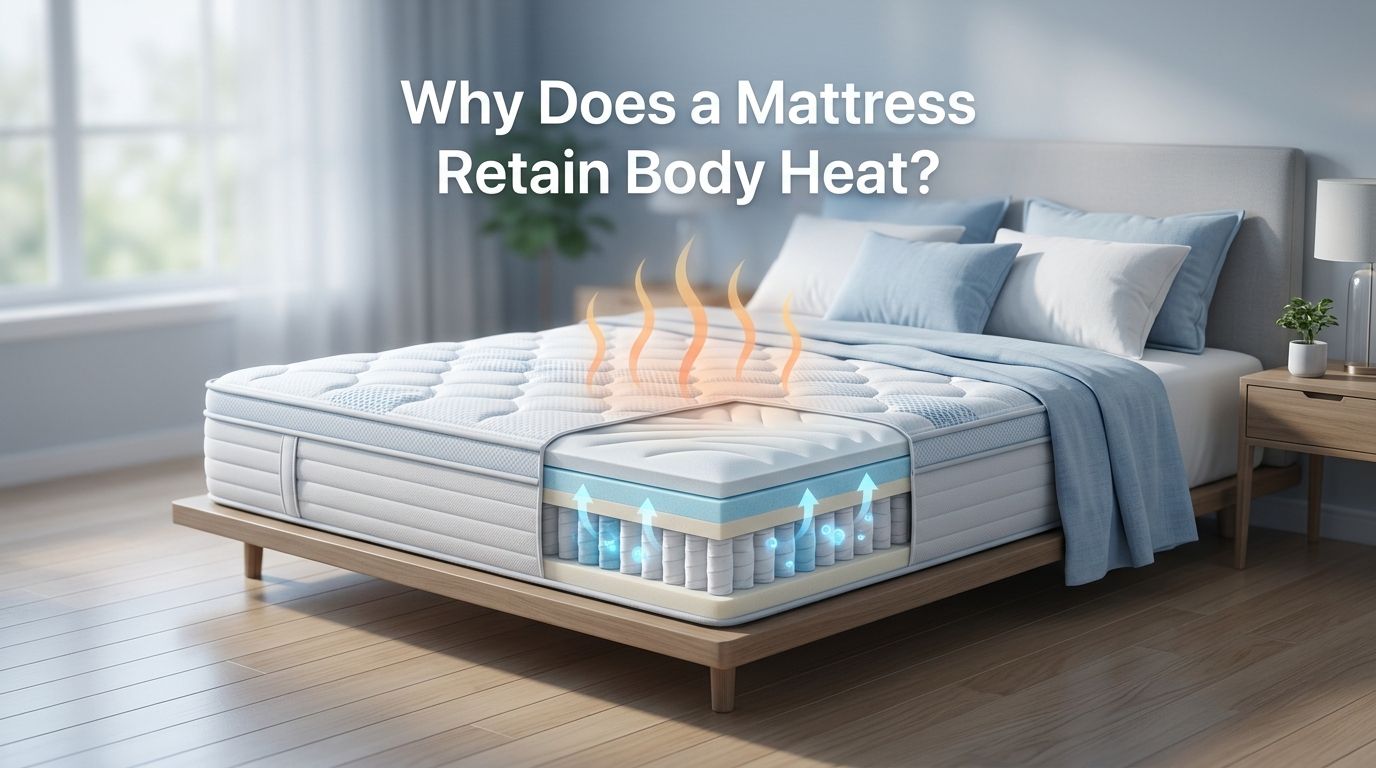
Why Does a Mattress Retain Body Heat? Smart Ways to Fix
Have you ever woken up in the middle of the night drenched in sweat, tossing your blankets aside? You are not alone.
Millions of people struggle with a mattress that traps heat and turns their bed into an oven. Your body temperature naturally drops during sleep, and a hot mattress fights against that process. The result is restless nights, frequent wake ups, and groggy mornings.
The problem often starts with the materials inside your mattress. Dense foams, synthetic fabrics, and poor airflow all play a role.
In a Nutshell
- Dense foam traps heat. Memory foam mattresses use closed cell structures that absorb your body heat and hold it against you all night. The foam softens with warmth, causing you to sink deeper, which increases the contact area between your body and the hot surface.
- Your bed frame matters more than you think. A solid platform base blocks air from circulating beneath your mattress. A slatted frame or breathable foundation allows heat to escape downward, making a noticeable difference in surface temperature.
- Breathable bedding is a simple fix. Swapping synthetic sheets for natural fibers like cotton percale, linen, or Tencel can lower the temperature you feel on your skin. These fabrics wick moisture and allow air to pass through.
- Room temperature plays a critical role. Sleep research from institutions like the Cleveland Clinic and UCLA recommends a bedroom temperature between 60 and 67°F (15 to 19°C) for the best sleep quality. A hot room compounds the heat your mattress already holds.
- Cooling toppers and active cooling systems work. A gel infused or latex mattress topper adds a breathable layer between you and the foam. Active bed cooling systems circulate water or air through your bed for a more powerful effect.
- Small changes add up. From elevating your mattress off the floor to running a fan in your bedroom, each step reduces heat buildup. You do not need one expensive solution. A combination of small fixes often delivers the best results.
How Your Body Regulates Temperature During Sleep
Your body follows a natural temperature cycle every 24 hours. In the evening, your core body temperature begins to drop, signaling your brain that it is time to sleep. This drop continues through the night and reaches its lowest point about two to three hours before you wake up.
During REM sleep, your brain actually stops actively regulating your body temperature. This means the environment around you becomes even more important. If your mattress traps heat, your body cannot cool itself properly during these vulnerable sleep stages.
Research published in Frontiers in Neuroscience confirms that body cooling and sleep onset are deeply connected. A hot mattress disrupts this process and can reduce the amount of deep, restorative sleep you get each night.
Why Dense Foam Mattresses Trap the Most Heat
Memory foam is one of the most popular mattress materials. It conforms to your body, relieves pressure points, and supports your spine. But it has a well known downside: it absorbs and retains body heat.
The reason lies in its structure. Traditional memory foam uses closed cell construction, meaning air cannot flow through the material. Your body heat gets absorbed into the foam and has no path to escape. The foam also softens as it warms, pulling you deeper into the surface.
This creates a “hugging” effect that feels cozy at first but quickly becomes uncomfortably warm. The more surface area of your body that touches the foam, the more heat transfers into it and stays trapped.
Pros of memory foam: Excellent pressure relief, motion isolation, spinal alignment.
Cons of memory foam: High heat retention, slow response time, can feel suffocating in warm climates.
The Role of Mattress Materials in Heat Retention
Not all mattresses trap heat the same way. The type of material inside your mattress determines how much heat builds up and how quickly it dissipates.
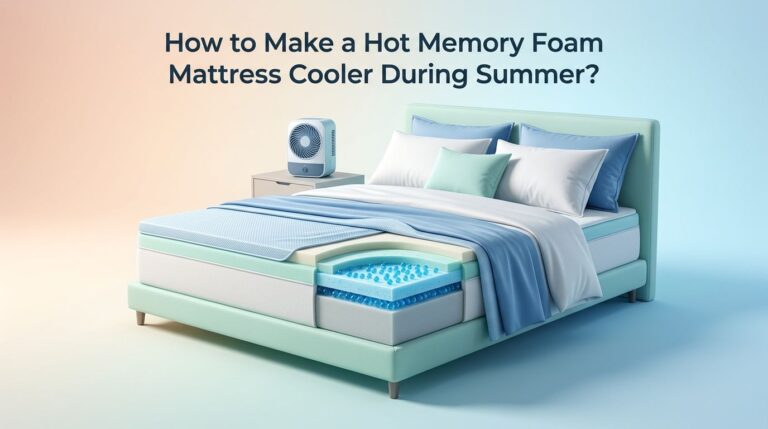
Closed cell polyurethane foam retains the most heat. It is cheap to produce and found in many budget mattresses. Open cell foam performs better because tiny air pockets allow some ventilation. Gel infused foam adds phase change materials that absorb heat and release it slowly, though the cooling effect can fade after a few hours.
Natural latex sleeps significantly cooler than memory foam. Its pin core design features small holes throughout the material that promote airflow. Latex also does not soften with heat, so you stay on top of the surface rather than sinking in.
Innerspring and hybrid mattresses tend to sleep the coolest. The coil layer allows air to circulate freely inside the mattress, carrying heat away from the sleep surface.
How Your Bed Frame Affects Mattress Temperature
Your bed frame plays a bigger role in heat retention than most people realize. A solid platform base acts like a wall beneath your mattress. Heat that moves downward has nowhere to go, so it reflects back up into the foam.
A slatted bed frame solves this problem. The gaps between slats allow air to circulate beneath your mattress. This ventilation helps carry trapped heat away from the sleep surface. Experts recommend slats spaced no more than three inches apart for proper support and airflow.
If you currently place your mattress directly on the floor, this is one of the worst setups for heat retention. The floor blocks all airflow underneath and can also trap moisture, creating conditions for mold growth. Elevating your mattress even a few inches makes a measurable difference.
Pros of slatted frames: Better ventilation, reduced moisture buildup, affordable.
Cons of slatted frames: Slats too far apart can damage foam mattresses, may feel less sturdy than solid platforms.
Why Your Bedding and Sheets Contribute to Overheating
Your sheets and blankets form the first layer of contact with your skin. If they trap heat, it does not matter how cool your mattress is underneath. Synthetic fabrics like polyester and microfiber are poor at releasing heat. They do not breathe well and tend to hold moisture against your body.
Natural fibers perform much better. Cotton percale with a lower thread count (around 200 to 300) offers a crisp, cool feel because its weave allows more airflow. Linen is even more breathable and improves with each wash. Tencel (lyocell), made from eucalyptus pulp, wicks moisture efficiently and feels cool to the touch.
Switching your bedding is one of the easiest and most affordable changes you can make. Many hot sleepers report an immediate improvement after moving to breathable, natural fiber sheets.
Use a Cooling Mattress Topper to Create a Barrier
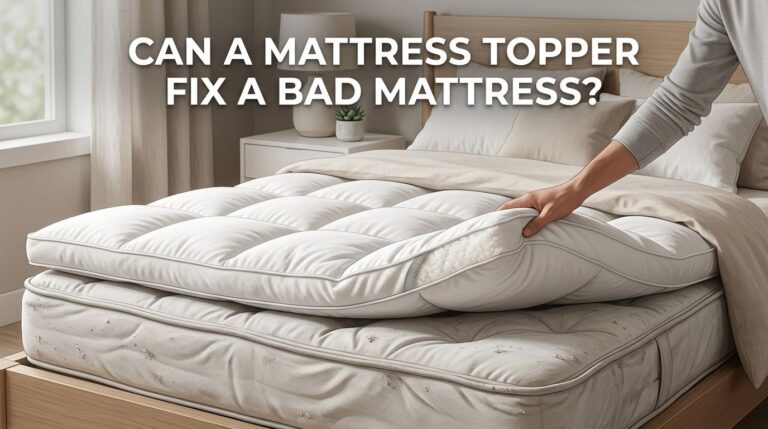
A cooling mattress topper sits between you and your mattress. It creates a breathable buffer zone that prevents your body heat from sinking directly into the foam below.
Gel infused foam toppers absorb heat from your body and distribute it across a larger surface area. They provide a cooling sensation initially, though the effect can diminish over several hours as the gel reaches its heat capacity.
Natural latex toppers offer more consistent temperature regulation. The open cell structure and pin core holes allow continuous airflow. Latex does not absorb heat the way foam does, so the surface stays neutral rather than warming up.
Wool toppers may sound warm, but wool is actually a natural temperature regulator. It wicks moisture away from your body and releases it into the air, keeping you dry and comfortable.
Pros of cooling toppers: Affordable, easy to add and remove, extend mattress life.
Cons of cooling toppers: Gel effects can fade overnight, adds height to your bed, quality varies widely.
Set Your Bedroom to the Right Temperature
Room temperature directly affects how hot your mattress feels. If your bedroom stays above 70°F (21°C), your mattress cannot release heat efficiently because the surrounding air is already warm.
Sleep experts at the Cleveland Clinic recommend keeping your bedroom between 60 and 67°F (15 to 19°C). This range supports your body’s natural temperature drop and promotes deeper sleep stages. A study from Harvard affiliated researchers found that for every 1°F increase in bedroom temperature above the optimal range, sleep efficiency decreased.
Use a programmable thermostat to lower the temperature before bed. If air conditioning is not available, open windows to create cross ventilation in the evening. Even a small reduction in ambient temperature helps your mattress release stored heat more effectively.
Improve Air Circulation in Your Bedroom
Stagnant air makes heat problems worse. When air does not move, the warm layer around your mattress and body stays in place. A simple fan can break this cycle by moving cooler air across your sleep surface.
Place a floor fan or tower fan near your bed, angled so it creates gentle airflow across the mattress. A ceiling fan on low speed also works well. The moving air helps evaporate moisture from your skin, which produces a natural cooling effect.
If your bedroom has poor ventilation, consider keeping the door open at night. This allows warm air to escape and cooler air from other parts of your home to flow in. Combining a fan with an open window creates effective cross ventilation that can lower the perceived temperature by several degrees.
Consider an Active Bed Cooling System
If passive solutions are not enough, active bed cooling systems offer the most powerful temperature control. These devices circulate chilled water or cooled air through a pad that sits on top of your mattress.
Water based systems pump temperature controlled water through a network of thin tubes inside a mattress pad. You set your preferred temperature, and the system maintains it throughout the night. Air based systems blow temperature regulated air directly into your bedding.
These systems can cool your sleep surface by 10 to 15 degrees below room temperature. They work especially well for people who share a bed, since many models offer dual zone controls so each sleeper can set a different temperature.
Pros of active cooling systems: Most effective cooling method, adjustable temperature, dual zone options.
Cons of active cooling systems: Higher upfront cost, require electricity, some models produce low noise.
Adjust Your Sleepwear and Pre Bed Routine
What you wear to bed and what you do before sleep affect your body temperature. Heavy pajamas made from synthetic materials trap heat against your skin. Switch to lightweight, breathable sleepwear made from cotton, bamboo, or moisture wicking fabric.
Your pre bed routine also matters. A warm shower 60 to 90 minutes before bed actually helps you sleep cooler. The warm water brings blood to the surface of your skin. After you step out, your body temperature drops rapidly, which signals your brain to initiate sleep.
Avoid intense exercise within two hours of bedtime. Physical activity raises your core temperature, and it takes time for your body to cool back down. Eating heavy meals close to bedtime also generates metabolic heat that can make you feel warmer in bed.
Choose the Right Mattress Material If You Sleep Hot
If your current mattress is due for replacement, choosing the right material can prevent heat problems from the start. Hot sleepers should prioritize breathability and airflow over deep contouring.
Hybrid mattresses combine foam comfort layers with an innerspring coil base. The coil layer allows air to circulate inside the mattress, significantly reducing heat retention. Many hybrid models also use gel foam or latex in the comfort layer for additional cooling.
Natural latex mattresses sleep cooler than any all foam option. The material does not absorb body heat, and its open structure promotes continuous air movement. Latex is also durable, often lasting 15 to 20 years.
All foam mattresses with open cell construction and cooling gel perform better than traditional memory foam. Look for models that specifically list airflow channels or ventilated foam layers in their design.
Pros of hybrid and latex options: Cooler sleep surface, better airflow, durable.
Cons of hybrid and latex options: Higher price point, heavier, latex has a different feel than foam.
Combine Multiple Cooling Strategies for Best Results
No single solution works perfectly for everyone. The most effective approach combines several strategies that work together. Start with the changes that cost nothing, then add more if needed.
Begin by adjusting your room temperature and improving airflow with a fan. Switch to breathable sheets and lightweight sleepwear. Check your bed frame and upgrade to a slatted base if you are using a solid platform or floor setup.
If these changes help but are not enough, add a cooling mattress topper for an extra layer of temperature regulation. For persistent overheating, an active cooling system provides the most reliable and controllable results.
Track your changes and notice which ones make the biggest difference for your body. Everyone generates different amounts of heat during sleep, so your ideal combination will be personal to you. The goal is to create an environment where your body can cool itself naturally without fighting your mattress.
Frequently Asked Questions
Why does my memory foam mattress get so hot at night?
Memory foam uses a dense, closed cell structure that absorbs your body heat and does not allow air to flow through it. As the foam warms up, it softens and causes you to sink deeper. This increases the contact area between your body and the foam, trapping even more heat. The combination of poor airflow and high heat absorption makes memory foam one of the warmest mattress types available.
What is the best bedroom temperature for sleeping?
Most sleep experts recommend a bedroom temperature between 60 and 67°F (15 to 19°C). This range supports your body’s natural nighttime temperature drop and promotes better deep sleep and REM sleep. Research from the Cleveland Clinic and other institutions consistently points to this range as ideal for most adults.
Do cooling mattress toppers actually work?
Yes, cooling mattress toppers can make a real difference. Gel infused toppers absorb initial body heat and provide a cooler feeling at the start of the night, though the effect may fade after several hours. Latex and wool toppers offer more consistent temperature regulation throughout the night because they promote airflow and moisture wicking rather than relying on heat absorption alone.
Can a bed frame make my mattress cooler?
Absolutely. A slatted bed frame allows air to circulate beneath your mattress, helping heat escape downward. A solid platform or placing your mattress on the floor blocks all airflow underneath, trapping heat and moisture. Switching to a slatted base is one of the simplest and most cost effective ways to reduce mattress heat retention.
Is it worth investing in an active bed cooling system?
If you are a consistently hot sleeper and passive methods have not solved the problem, an active cooling system can be worth the investment. These systems can lower your mattress surface temperature by 10 to 15 degrees below room temperature and maintain it all night. Dual zone models also allow partners with different temperature preferences to each set their own comfort level.

Hi, I’m Ava Day, the founder and lead writer at Cozy Bed Vault. I’m passionate about sleep wellness and dedicated to helping people find their perfect mattress. Through honest reviews, detailed comparisons, and expert buying guides, I simplify the mattress shopping experience so you can sleep soundly every night.