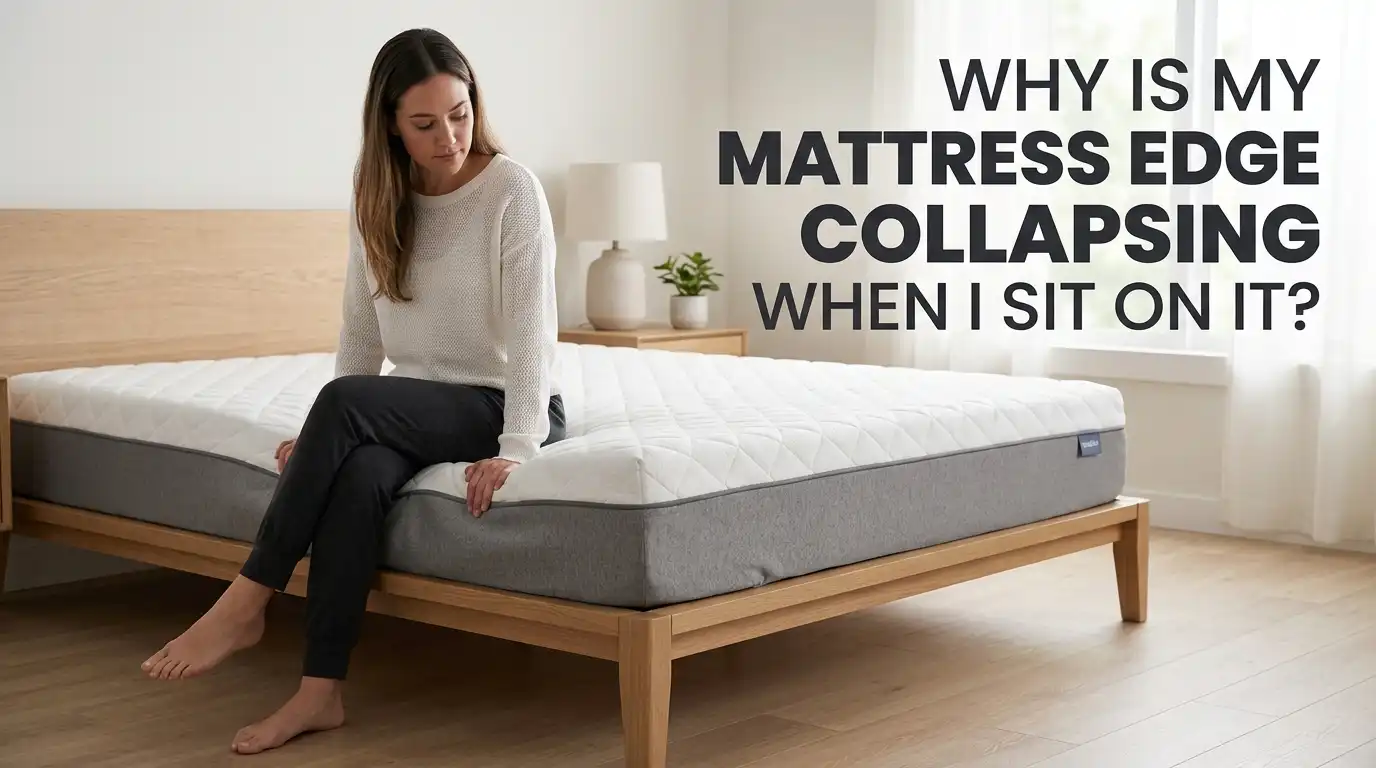
Why Is My Mattress Edge Collapsing When I Sit On It?
You sit on the side of your bed to tie your shoes, and the edge sinks like a deflating balloon. Maybe you roll too close to the side at night and feel like you might slide off. If this sounds familiar, you are not imagining things.
A collapsing mattress edge is one of the most common complaints sleepers report, and it can make your whole bed feel smaller, weaker, and far less comfortable than it should be.
The good news is that this problem usually has a clear cause. Sometimes it is the foam. Sometimes it is the frame underneath. Sometimes it is just how you use the bed every single day.
In a Nutshell:
- Edge collapse usually means the perimeter materials have worn out or were weak from the start. Cheap, low density foam breaks down fast, especially where you sit every day.
- The edge takes more abuse than the center. When you sit on the side, your full body weight presses into a small area, which crushes the foam faster than lying down ever could.
- The frame matters as much as the mattress. Wide slat gaps, a sagging box spring, or a weak center beam let the edges bend and dip even on a good mattress.
- Most edge problems have a fix you can do at home. Rotating the mattress, adding plywood, using firm support boards, or changing where you sit can all help right away.
- Coil edge support beats foam encasement for durability in most cases, though foam works fine in lighter use. Knowing the difference helps you buy smarter next time.
- Sag deeper than 1 to 1.5 inches may qualify for a warranty claim. Always measure before you assume you must buy a new bed.
What Mattress Edge Collapse Actually Means
Mattress edge collapse happens when the perimeter of your bed loses its firmness and sinks under pressure. The edge should hold your weight when you sit or sleep near the side. When it caves in, the support structure has broken down.
Think of your mattress like a frame around a picture. The center holds your body at night, but the edges keep the whole thing stable. When the edges fail, the usable sleep surface shrinks, and the bed feels smaller than it really is.
Most people first notice the problem when they sit down to dress or get up in the morning. The side dips sharply, and you feel like you are sliding off. This is not normal wear you have to accept. It points to a specific weakness in either the foam, the coils, or the foundation underneath.
Why The Edge Wears Out Faster Than The Middle
Here is something many people miss. The edge of your mattress works harder than any other spot. When you lie down, your weight spreads across a large area. When you sit on the side, all of that weight presses into a tiny zone.
This concentrated pressure crushes the foam cells faster. A spot the size of your hips takes the load of your entire upper body every single time you sit. Over months and years, that adds up to thousands of compressions in one small area.
People also tend to sit on the same side every day. The dominant edge wears out while the rest of the bed stays firm. This creates that lopsided, sunken feeling. The material simply gives up before the center does because it never got a fair share of the work spread across it.
Cheap Or Low Density Foam Is The Usual Culprit
The single biggest cause of edge collapse is low quality foam. The cheaper the foam, the less material packed inside it, and the faster it loses strength. Density is the key number here, and it tells you how much actual foam fills each cubic foot.
For edge support rails, a density of around 1.8 pounds per cubic foot is a reasonable baseline. Anything lower will crush quickly, especially under heavier bodies or daily sitting. Higher density foam holds its shape far longer.
The Pros and Cons of foam edge support look like this. On the plus side, foam encasement is lighter, cheaper, and gives a clean uniform feel around the bed.
On the down side, foam softens over time, develops soft spots, and rarely matches the durability of coils. If your mattress edge failed within a year or two, weak foam is the most likely reason.
When Worn Out Coils Cause The Sinking Feeling
Innerspring and hybrid mattresses rely on metal coils for support. Over time, these coils can lose tension, especially near the edge where many beds use thinner or fewer springs. When the coils stop pushing back, the edge sags.
Some mattresses use a steel rod or a row of firmer coils around the perimeter. This edge to edge coil system gives firmer support and resists sagging better than foam. When it works, you barely feel the difference between the center and the side.
The Pros and Cons of coil edge support are worth knowing. The advantages include stronger long term durability, better airflow, and a firmer sit.
Tests show some coil edge systems run more than 25 percent more durable than foam encasement. The drawbacks are extra weight, a slightly firmer feel right at the border, and a higher price. Still, for heavy daily use, coils usually win.
How A Bad Bed Frame Makes Everything Worse
Here is a fact that surprises many people. A lot of what feels like mattress sag is actually frame failure. Your mattress can only be as supportive as the surface beneath it.
Wide gaps between slats let the mattress bend and droop into the empty spaces. A weak or missing center support beam allows the whole bed to bow. Loose joints and wobbly legs add even more instability. The edge then dips because nothing holds it up.
Check your frame before blaming the mattress. Slats should sit no more than 2 to 3 inches apart for foam beds. A queen or king needs a strong center leg touching the floor.
If your frame fails any of these checks, fixing it may solve your edge problem completely without spending a cent on a new mattress.
Step By Step: How To Diagnose The Real Cause
Before you fix anything, you need to know what is actually wrong. Follow these simple steps to find the source of your sinking edge.
First, strip the bed and look at the mattress alone on the floor. Sit on the edge there. If it still collapses, the mattress is the problem. If it feels firm, your frame is the culprit.
Second, lay a straight board or level across the surface. Measure the deepest dip with a ruler. This tells you how severe the sag really is and whether it might qualify for a warranty.
Third, inspect the frame. Push on the slats, check the center beam, and look for cracks or bowing. Fourth, check the mattress age. Most mattresses last 7 to 10 years before materials break down. If yours is older, wear is expected. These four checks point you straight to the fix you need.
Fix Number One: Rotate Your Mattress Regularly
Rotating your mattress is the easiest and cheapest fix you can try. Turning it 180 degrees moves the worn edge to a fresh position and lets the crushed foam recover while the other side takes a turn.
Aim to rotate every 3 to 6 months. Set a reminder on your phone so you do not forget. This simple habit spreads the wear evenly and slows down edge collapse on the side you use most.
The Pros and Cons here are clear. The benefits are that it costs nothing, takes only a couple of minutes, and extends the life of your bed. The limit is that rotation only works on mattresses designed for it.
Many modern foam and hybrid beds are one sided, so you cannot flip them. Still, rotating top to bottom helps almost any bed. If your edge just started sagging, try this first.
Fix Number Two: Add Plywood Or Support Boards
If your frame flexes or your slats sit too far apart, a sheet of plywood can work wonders. Plywood removes the flex and creates a flat, rigid base that stops the mattress from bending into gaps.
Measure your bed, then cut a half inch or three quarter inch plywood sheet to fit. Lay it directly on the slats, under the mattress. Sand any rough edges so it does not snag the fabric. This instantly firms up a sagging foundation.
The Pros and Cons of plywood are easy to weigh. On the plus side, it is cheap, strong, and fixes frame related sag fast.
On the down side, solid plywood blocks airflow, which can trap moisture and lead to mold over time. To avoid this, drill a few ventilation holes or use slatted board sections instead. For a quick, affordable fix, plywood is hard to beat.
Fix Number Three: Use An Edge Support Insert
When the mattress foam itself has worn out, you can prop it back up from below or beside the sag. A high density foam insert slipped under the weak edge restores some of the lost height. You can also tuck a firm rolled towel or pool noodle along the border under the fitted sheet for a temporary lift.
Look for inserts made of high density foam, ideally above 1.8 pounds per cubic foot, so they do not crush as fast as the foam they are replacing.
The Pros and Cons matter here. The upside is that inserts are inexpensive and can buy you months or even years of extra use. The downside is that they are a patch, not a cure.
The underlying foam is still failing, and you will feel a seam or ridge where the insert sits. Use this fix when you are not ready to replace the bed but need relief now.
Fix Number Four: Change Where And How You Sit
Sometimes the smartest fix costs nothing and just changes your habits. Since the edge wears out from repeated sitting, sitting somewhere else protects it.
Try sitting closer to a corner where the frame gives extra support. Better yet, use a bench or chair at the foot of the bed for putting on shoes and getting dressed. This keeps your full weight off the soft border foam.
If you must sit on the bed, switch sides now and then so one edge does not take all the abuse. Spreading the load helps the foam last longer.
The Pros and Cons are simple. The benefit is that it is free and prevents future damage. The drawback is that it does not repair existing collapse, and changing old habits takes effort. Pair this with rotation, and you give your mattress edge a real chance to last.
How To Check If Your Warranty Covers The Sag
Before you spend money on fixes or a new bed, check your warranty. Many mattress warranties cover sagging beyond a certain depth, and you may be able to get a replacement for free.
Most warranties consider a sag of 1 to 1.5 inches a defect that qualifies for a claim. To measure, lay a straight edge across the mattress, then use a ruler to find the deepest point of the dip.
Take clear photos and keep your receipt. One important warning: stains usually void the warranty entirely, so always use a mattress protector. Inspectors check for stains first.
The Pros and Cons of a warranty claim are worth noting. The upside is a possible free fix or replacement. The downside is that claims can be slow, picky about measurements, and may not cover edge only wear if the center is fine. Still, it costs nothing to check.
What To Look For When Buying Your Next Mattress
If your current bed is past saving, shop smarter next time. Edge support is something you can test before you buy. Sit firmly on the side in the showroom and feel whether it holds you or caves in.
Ask about the edge support system specifically. Look for reinforced coils or a high density foam encasement around the perimeter. For coil systems, edge to edge coils give the firmest, longest lasting support.
Match the bed to your body. Heavier sleepers and people who sit on the edge daily need stronger edge support than lighter, occasional users.
The Pros and Cons of prioritizing edge support are worth weighing. The benefits include a larger usable sleep surface, easier getting in and out, and longer mattress life. The trade off is that strong edge support usually costs more and can feel slightly firmer at the border. For most people, that trade is well worth it.
Frequently Asked Questions
How long should a mattress edge last before it sags?
A quality mattress should hold its edge support for around 7 to 10 years. If your edge collapses within the first year or two, that points to low density foam or a manufacturing defect. Cheaper beds with thin foam edges often fail much sooner, especially under daily sitting or heavier body weight. Check your warranty if early sagging appears, since premature collapse may qualify for a replacement.
Can I fix a collapsed mattress edge myself?
Yes, in many cases you can. Rotating the mattress, adding plywood under a weak frame, or slipping a high density foam insert under the sagging edge can all restore support at home. These fixes work best when the cause is mild wear or a flexing foundation. If the foam is badly broken down or the bed is over a decade old, repairs only buy time and replacement becomes the better choice.
Is foam or coil edge support better?
Coil edge support generally lasts longer and feels firmer, with some systems testing over 25 percent more durable than foam. Foam encasement is cheaper and lighter but softens faster over time. For heavy daily use or sitting on the edge often, coils are usually the smarter pick. For lighter, occasional use, good high density foam can still perform well for years.
Does putting plywood under my mattress really help?
It helps a lot when the problem is a flexing frame or wide slat gaps. Plywood creates a flat, rigid base that stops the mattress from bending into empty spaces. Just drill a few holes for airflow, since solid boards can trap moisture and lead to mold. Plywood will not repair foam that has already broken down inside the mattress itself, so match the fix to the cause.
Will sitting on my mattress edge ruin it?
Sitting on the same edge every day does speed up wear. Your full upper body weight presses into a small area, crushing the foam far faster than lying down. Using a bench or chair to put on shoes, sitting near a corner, or switching sides helps protect the border. Combine this habit change with regular rotation, and your mattress edge will last considerably longer.
When should I just replace the mattress?
Replace it when the foam or coils have broken down beyond repair, usually after 7 to 10 years. Signs include sag that returns right after every fix, deep permanent dips over 1.5 inches, or visible body impressions that no longer bounce back. If home fixes only help for a short while and the whole bed feels tired, a new mattress with strong edge support is the lasting solution.
Note: Sleep quality affects your health, so if poor sleep is wearing you down, it is worth taking seriously and addressing sooner rather than later.

Hi, I’m Ava Day, the founder and lead writer at Cozy Bed Vault. I’m passionate about sleep wellness and dedicated to helping people find their perfect mattress. Through honest reviews, detailed comparisons, and expert buying guides, I simplify the mattress shopping experience so you can sleep soundly every night.