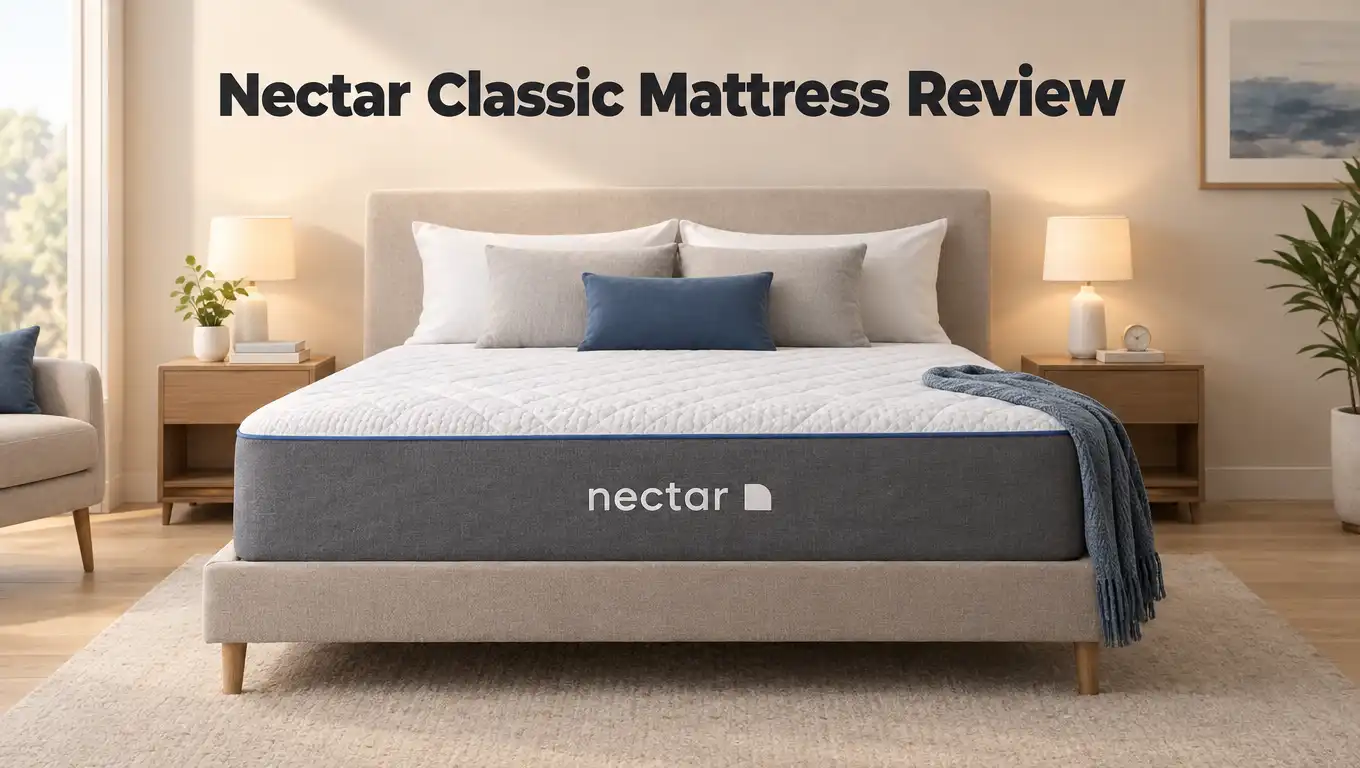
Nectar Classic Mattress Review 2026: Still Worth It?
Buying a mattress online feels like a gamble. You cannot lie on it first. You cannot poke the foam. You just click, wait for a box, and hope you sleep well.
The Nectar Classic has been the default answer for budget shoppers since 2017, and in 2026 it still sits near the top of almost every “best cheap memory foam” list.
This review breaks down what the Nectar Classic actually feels like, how it performs in real tests, where it disappoints, and who should buy something else instead. No fluff. No sales pitch. Just what you need before you spend a few hundred dollars on something you will sleep on for the next several years.
Key Takeaways
- The Nectar Classic is a medium firm all foam mattress. Most testers rate it around 6 out of 10 on the firmness scale. That works for back sleepers, stomach sleepers, and most side sleepers under 250 pounds.
- It does not feel like classic memory foam anymore. The 2024 redesign cut the gel memory foam down to one inch. You get a slight body contour instead of a deep hug. If you want that quicksand feeling, look at the Nectar Premier instead.
- Cooling is surprisingly good for foam. Surface temperature stayed about 1.4 degrees cooler than average in lab testing. Thinner memory foam means less heat trapping.
- Edge support is the standout feature. Sitting sinkage measured just 3.25 inches, which beats most foam beds and even some hybrids.
- The value is hard to beat. A queen usually lands near $649, roughly 40 percent below the average memory foam mattress, and it ships with a 365 night trial plus a lifetime warranty.
- The weak spots are real. Slow response time, modest bounce, average pressure relief, and a strong chemical smell for about six days after unboxing.
What Is the Nectar Classic Mattress?


Last update on 2026-10-19 / Affiliate links / Images from Amazon Product Advertising API
The Nectar Classic is the entry level model in the Nectar lineup. It is an all foam bed in a box mattress that measures about 11.5 inches thick, even though the marketing says 12 inches. Resident Home manufactures it in Jeffersonville, Indiana.
The build is simple. You get a stretchy poly blend cover, a thin gel memory foam comfort layer, a thicker poly foam transition layer, and a dense support core underneath. There are no coils, no zoned support, and no reinforced edge rails. It comes in one firmness only, so there is no soft or firm version to pick from.
Nectar sells it as a memory foam mattress, but in practice it behaves like a balanced foam mattress. That distinction matters more than the label, and we will get into why shortly.
The Unboxing Experience
The box arrives heavy. A queen weighs roughly 75 pounds and a king pushes past 80, so grab a second person. There are no carry handles on the box or the mattress, which is genuinely annoying when you are dragging it up stairs.
Inside, the mattress is vacuum sealed in thick plastic and rolled tight. Nectar includes a small plastic cutter in some shipments. Slice the outer wrap, unroll the mattress onto your frame, then cut the inner bag. It expands fast. Most of the shape returns within an hour.
Then comes the smell. Off gassing on this mattress is strong. Testers describe it as wet paint. It faded in about six days with a window cracked open, which is one day faster than average, but it is still noticeable. Plan to air it out in a spare room for at least 48 hours before sleeping on it.
Firmness and Feel Explained
Most independent testers land on 6 out of 10 for the Nectar Classic, which is true medium firm. Some rate it as high as 6.5. You will feel a gentle cradle at your shoulders and hips, then firm pushback underneath.
Measured sinkage came in at 1.91 inches, which is shallower than the 2.14 inch average. In plain words, you sleep more on top of this mattress than inside it. Lighter sleepers under 130 pounds may find it firmer than expected because they cannot press far enough into the comfort layers.
The feel is neutral rather than dramatic. Fans of old school slow sinking memory foam will probably feel let down. Fans of a supportive, flat, easy to move on surface will be happy. Knowing which camp you fall into is the single best predictor of whether you will like this bed.
Top 3 Alternatives for Nectar Classic Mattress

Last update on 2026-10-19 / Affiliate links / Images from Amazon Product Advertising API
Zinus 12 Inch Green Tea Memory Foam Mattress

Last update on 2026-10-19 / Affiliate links / Images from Amazon Product Advertising API
Lucid 12 Inch Plush Gel Memory Foam Mattress

Last update on 2026-10-18 / Affiliate links / Images from Amazon Product Advertising API
Novilla Bliss 12 Inch Gel Memory Foam Mattress
Inside the Layers and Materials
The construction is three layers of foam stacked from thinnest to thickest as you move down.
The top layer is 1 inch of gel memory foam measured at 2.45 PCF density. This gives the light contour and handles some heat. Below that sits 3 inches of poly foam at 1.56 PCF, acting as a transition and doing most of the comfort work. The base is 7.5 inches of support foam at 1.61 PCF.
The cover blends 92 percent polyester with 8 percent polyethylene and has a diagonal quilted pattern. It is thin, soft, and stretchy. The mattress is fiberglass free, which matters because several budget foam brands have had fiberglass complaints.
Here is the honest read on materials. Those foam densities are modest. They are typical for the price bracket, but they are not premium numbers, and density is closely tied to how long a foam mattress holds its shape.
Cooling Performance and Heat Retention
This is where the Nectar Classic beat expectations. All foam beds usually trap heat. This one does not, at least not badly.
In controlled testing, the surface started at 76.5 degrees, peaked at 88.3 degrees after 15 minutes of body contact, and dropped back to 80.5 degrees five minutes later. That peak sits about 1.4 degrees below the average foam mattress.
The reason is simple. There is only one inch of memory foam, so there is less heat hoarding material near your body. The gel infusion helps a little. The thin, breathable cover helps too.
Hot sleepers should still set realistic expectations. This is cooler than most foam beds, not cooler than a coil hybrid with a phase change cover. If you wake up drenched every night, a hybrid moves more air than any all foam design can.
Pressure Relief and Sleep Positions
Pressure mapping showed no readings above 1.10 PSI in any position, and anything under 2.0 PSI counts as comfortable. Side sleepers averaged 0.22 PSI, back sleepers 0.12 PSI, and stomach sleepers 0.12 PSI. Those are solid numbers.
Back sleepers get the best experience here. The firm core keeps hips level with shoulders, which supports neutral spine alignment. Stomach sleepers also do well because there is not enough give for hips to sag.
Side sleepers are the mixed group. Lighter side sleepers sometimes report shoulder pressure after a few hours, since one inch of memory foam cannot swallow a shoulder the way three inches can. Pressure relief here is good, but it never reaches excellent. Heavier sleepers up to 300 pounds report adequate support thanks to the thick base.
Motion Transfer for Couples
Foam absorbs movement, and the Nectar Classic does a decent job. Accelerometer testing measured a range of 9.49 meters per second, which is about 8 percent more motion transfer than average. Motion settled back to near zero within 0.82 seconds.
In everyday terms, your partner rolling over will barely register on your side of the bed. Someone climbing out at 5am might create a small ripple, but nothing that yanks you awake.
There is one catch for couples. Bounce measured only 8.07 inches, well under the 9.57 inch average. Low bounce makes intimacy feel a bit sluggish and makes repositioning harder. The mattress is also completely silent, with no springs to squeak, which some couples value more than bounce. Weigh which of those two traits matters more to you.
Edge Support and Usable Surface
This is the Nectar Classic’s best trick, and it is unusual for a foam bed.
Sitting on the very edge produced only 3.25 inches of compression, compared to a 4.01 inch average. The perimeter holds firm instead of collapsing. Lying on the edge felt equally stable in back, side, and stomach positions.
There is no reinforced perimeter foam in this mattress. The strong edge comes from having 10.5 inches of firm support foam and only one inch of soft material on top. The same design choice that limits pressure relief pays off here.
Why this matters day to day. Couples get the full width of the bed instead of a soft mushy border. Anyone who sits on the edge to put on shoes stays level. People with limited mobility who push off the edge to stand up get reliable support.
Durability and Long Term Performance
Here is the part sales pages skip. Foam density predicts lifespan, and these densities are average at best. A 2.45 PCF memory foam layer over 1.56 PCF poly foam is normal for a $649 queen, but it is not built like a $1,500 mattress.
Owner reports back this up. Many people sleep happily for years. Others report a body impression forming near the center within 12 to 24 months, especially heavier sleepers. Some of those owners also report frustration with warranty claims, because Nectar requires a sagging depth of at least 1 inch on a properly supported foundation before it approves a replacement.
Protect yourself with two simple steps. Use a rigid foundation or slats spaced no more than 3 inches apart, since inadequate support voids the warranty. Rotate the mattress head to foot every three months to spread wear evenly.
Price, Sizes and Overall Value
Last update on 2026-10-19 / Affiliate links / Images from Amazon Product Advertising API
Typical Nectar pricing runs around $349 for a twin, $549 for a twin XL, $599 for a full, $649 for a queen, $849 for a king or California king, and $1,098 for a split king. Nectar runs sales constantly, so the list price is rarely what you pay.
That queen price sits roughly 40 percent below the average memory foam mattress, a saving of over $400. Among every memory foam bed independently tested, the Classic is cheaper than about 65 percent of them, and only one cheaper model actually outperforms it.
Value is the strongest argument for this mattress. Performance is close to average across the board. The price is far below average. That gap is the whole pitch, and it is a fair one.
Trial Period, Warranty and Delivery
Nectar’s policy package is genuinely one of the best in the industry, and it removes most of the risk of buying online.
You get a 365 night home trial, compared to an industry average near 178 nights. That is a full year to decide. Nectar asks you to sleep on it for at least 30 nights first, which is reasonable since foam needs time to break in and your body needs time to adjust.
The warranty is a lifetime warranty for the original owner. Only about a quarter of mattress brands offer that. Shipping is free, and returns are free too. If you send it back, Nectar arranges pickup or donation and refunds you.
Read the warranty fine print on foundation requirements. It is the clause that trips up most rejected claims.
Pros and Cons of the Nectar Classic
Pros
- Excellent value. A queen near $649 undercuts most memory foam competitors by hundreds of dollars.
- Strong edge support. Just 3.25 inches of sitting compression, which is better than many hybrids.
- Good cooling for an all foam bed. Peak surface temperature ran cooler than average in testing.
- Low motion transfer and zero noise. Movement settles in under a second and nothing squeaks.
- Best in class policies. 365 night trial, lifetime warranty, free shipping, free returns.
- Works for most body types. Supports sleepers up to 300 pounds in all three sleeping positions.
- Fiberglass free construction with a CertiPUR certified foam build.
Cons
- Slow response time. Foam takes 1.3 seconds to fully recover, so you feel slightly stuck.
- Low bounce. 8.07 inches of total bounce sits well below average.
- Strong off gassing that lingers for roughly six days.
- Only one firmness option. No soft or extra firm choice.
- Average foam densities raise reasonable questions about long term durability.
What the Nectar Classic Does Not Do Well
Honesty time. This mattress is not a true memory foam experience. If you bought a Nectar in 2018 and loved the deep hug, the 2026 version will feel like a different product. One inch of memory foam cannot recreate that.
Pressure relief is good, not great. Petite side sleepers with sharp shoulders are the most likely group to feel a pressure point. A soft topper fixes this, but needing a topper on a new mattress is a real cost.
Movement on the surface feels sluggish. Combination sleepers who switch positions often will notice the foam lagging behind them. The low bounce compounds it.
There is no firmness choice. One feel has to work for everybody, and it will not.
Long term durability is the open question. The foam specs are ordinary. Plenty of owners are fine at year three. Others report sagging by month eighteen.
Who Should Buy It and Who Should Skip It
Buy the Nectar Classic if you want a supportive medium firm foam bed without spending over $1,000. It suits back sleepers, stomach sleepers, guest rooms, teenagers, couples who need motion isolation, and anyone who sits on the edge of the bed often. Budget shoppers get the most performance per dollar here.
Skip it if you crave that deep sinking memory foam hug, because the Premier or Luxe models deliver that better. Skip it if you are a lightweight side sleeper who needs serious shoulder cushioning. Skip it if you are a combination sleeper who values quick response and bounce, since a hybrid suits you more. Skip it if you sleep extremely hot, because coils beat foam for airflow every time.
The 365 night trial makes the decision low risk. If it does not work, you send it back free.
Frequently Asked Questions
Is the Nectar Classic the same as the original Nectar mattress?
No. The Classic is a redesign of the original. Nectar changed the cover, reduced the gel memory foam from 3 inches to 1 inch, and increased the poly foam layer to 3 inches in 2024. Independent testing scores the Classic noticeably higher than the older version.
How firm is the Nectar Classic?
It rates 6 out of 10, which is medium firm. There is only one firmness option available.
How long does the Nectar Classic take to expand?
It takes shape within about an hour and reaches full loft in 24 to 72 hours. Give it at least two days before judging the feel.
Does the Nectar Classic sleep hot?
It sleeps cooler than most all foam mattresses. Peak surface temperature measured 88.3 degrees, about 1.4 degrees below average. Very hot sleepers may still prefer a hybrid.
Is the Nectar Classic good for back pain?
Many back sleepers find the medium firm support helpful for spinal alignment. It is not a medical device, so talk to a doctor about persistent pain.
What foundation does the Nectar Classic need?
Use a solid platform, a slatted base with gaps under 3 inches, an adjustable base, or a box spring with a bunkie board. Poor support can void the warranty.
Does the Nectar Classic contain fiberglass?
No. The cover and foams are fiberglass free.
How long does the Nectar Classic last?
Expect roughly 6 to 8 years with proper support and regular rotation. Heavier sleepers may see body impressions sooner.

Hi, I’m Ava Day, the founder and lead writer at Cozy Bed Vault. I’m passionate about sleep wellness and dedicated to helping people find their perfect mattress. Through honest reviews, detailed comparisons, and expert buying guides, I simplify the mattress shopping experience so you can sleep soundly every night.