Mayton Vertical Wooden Bunkie Board Review 2026: Worth Buying?
Your mattress dips in the middle. Your slats creak every time you roll over. You start wondering if you need a new bed, when the real problem sits two inches below your sheets. That is the exact situation the Mayton Vertical Wooden Bunkie Board was built for.
This board is one of the quieter success stories on Amazon. It does not look impressive. It arrives folded like an accordion. Yet thousands of sleepers use it to rescue sagging beds, bunk beds, daybeds, and futon frames without buying a bulky box spring.
In this review, I break down the build, the unboxing, the real installation process, the weak points nobody mentions, and whether it still earns a spot in your bedroom in 2026.
In a Nutshell:
- The Mayton Vertical Wooden Bunkie Board is a set of linked wooden slats wrapped in a fabric cover. It sits between your mattress and your bed frame. It adds support without adding height, which keeps your bed profile low and your bunk bed clearance safe.
- The wood is black spruce from sustainably sourced Canadian softwood. The slats connect to each other with fabric webbing, so they roll out in one piece. There is no hardware, no tools, and no screws involved at any stage.
- Installation takes under five minutes. You lift the mattress, unroll the board across the frame, spread the slats evenly, and drop the mattress back down. Most buyers finish before their coffee cools.
- Full, Queen, King, and California King sizes still need a center support beam. The board distributes weight, but it does not replace a missing middle rail. Twin and Twin XL frames usually manage without one.
- It will not fix a dead mattress. If your foam has collapsed or your springs have failed, this board simply gives that worn mattress a flatter place to fail. It prevents future sagging rather than reversing old damage.
- The value is strong, the strength is moderate. Heavier sleepers, aggressive movers, and anyone wanting a rigid single panel should look at thicker options instead.
What Is the Mayton Vertical Wooden Bunkie Board?


Last update on 2026-10-21 / Affiliate links / Images from Amazon Product Advertising API
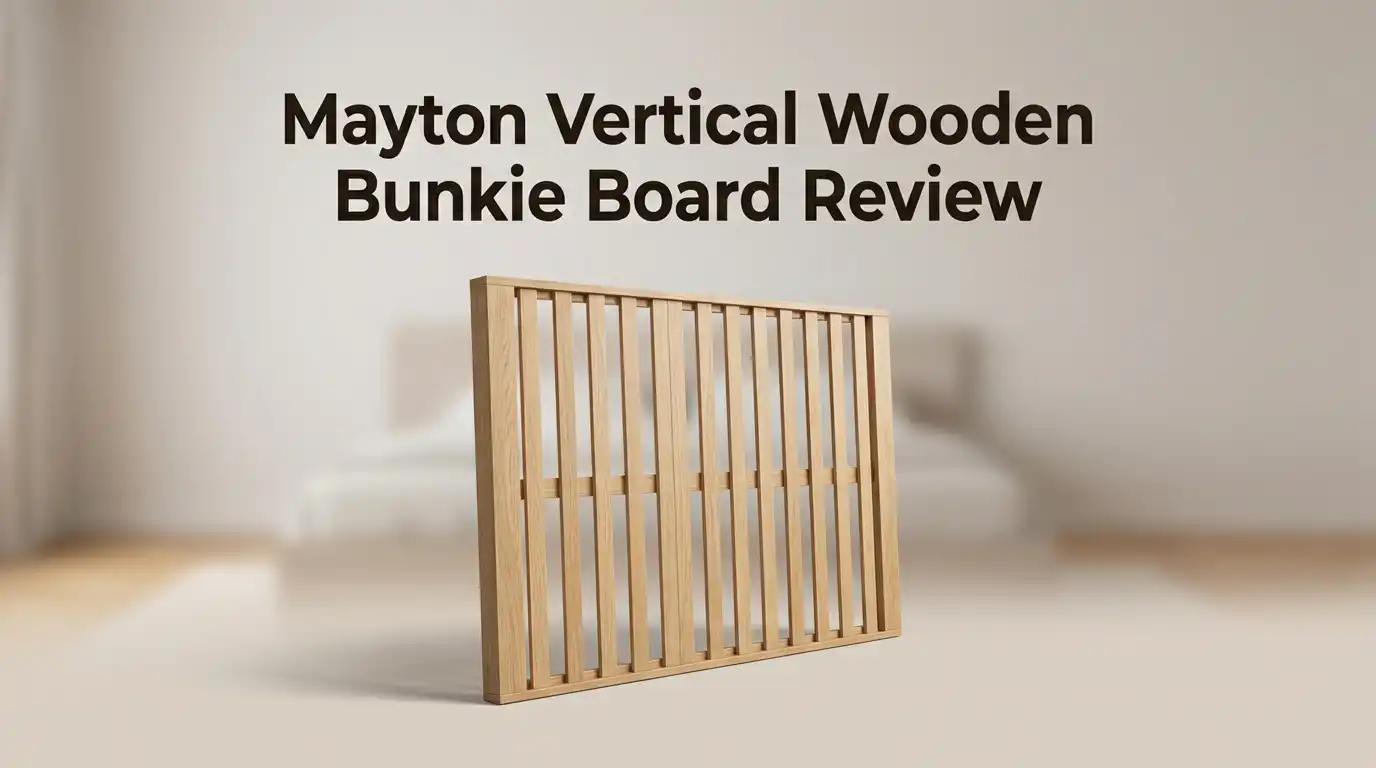
The Mayton Vertical Wooden Bunkie Board is a low profile mattress foundation made from linked wooden slats. Mayton wraps the slats in a woven fabric cover so the wood never touches your mattress directly. The slats run vertically, meaning they sit across the width of the bed and travel from the head of the frame to the foot.
The standard version measures about 0.68 inches thick. The heavy duty version measures about 0.75 inches. Both stay slim enough to disappear under a mattress. You gain support without raising your bed by six or eight inches.
Mayton builds these in the United States using Canadian black spruce. The company also sells horizontal versions and a split 1.5 inch assembled board. The vertical layout is the one most buyers choose, because it pairs well with center support beams that run lengthwise down the frame.
Unboxing Experience: What Actually Arrives
The box is long, flat, and surprisingly light. A Queen set weighs roughly 21 pounds, which one adult can carry up a staircase without help. The packaging is plain cardboard with minimal branding. Nothing fancy, nothing wasteful.
Inside, you find the slats folded in a zigzag stack, held together by the fabric webbing. There are no loose parts rattling around. There is no hardware bag to lose. A small instruction card shows the measuring diagram and the orientation guide.
The first thing you notice is the smell of fresh pine. It fades within a day or two. The second thing you notice is the fabric cover, which feels like a durable upholstery weave rather than cheap polyester.
Unfolding the board is oddly satisfying. You grab one end, walk it across the frame, and the whole thing opens like a fan. No sweating, no swearing, no missing instructions.
Build Quality and Materials
The wood is real spruce, not particleboard and not plywood. Each slat is sanded smooth before the fabric goes on. Run your hand along the edges and you feel finished wood instead of splinters.
The fabric cover does more than hide the wood. It keeps the slats from grinding against each other, which cuts down on squeaking. It also stops the wood from chewing up the bottom panel of your mattress. Buyers who replaced bare slats with this board consistently report less noise.
The webbing between slats is the one part to watch. It holds well under normal use, but it is fabric, not steel. Dragging the board across a rough frame can stress those connections.
Overall, the construction feels honest for the price. It is a well made budget product rather than a premium furniture piece, and Mayton never pretends otherwise.
Top 3 Alternative for Mayton Vertical Wooden Bunkie Board

Last update on 2026-10-21 / Affiliate links / Images from Amazon Product Advertising API
Meliusly Original Bunkie Board

Last update on 2026-10-21 / Affiliate links / Images from Amazon Product Advertising API
Zinus Deepak Easy Assembly Wood Slat Bunkie Board

Last update on 2026-10-21 / Affiliate links / Images from Amazon Product Advertising API
LAVEVE Heavy Duty Bunkie Board
Sizes, Dimensions, and Fit
Mayton offers Twin, Twin XL, Full, Full XL, Queen, King, and California King. The Twin measures roughly 73 by 38 inches. The Queen covers a 60 by 80 inch footprint and ships in two linked pieces for easier handling.
Measure the inside of your frame before ordering. Mattress labels and frame interiors do not always match. Measure between the side rails where the board will rest, then compare that number to the size chart.
Larger sizes arrive as two halves that sit side by side. This is intentional. Two pieces fit through doorways, up stairwells, and around tight corners far better than one rigid panel.
The fit is snug rather than loose on most standard frames. If your frame has corner posts or thick brackets, check the clearance first. A board that forces the rails outward creates new problems instead of solving old ones.
Installation Steps
Installation needs no tools. Here is the sequence that works best.
Remove your mattress and set it against a wall. Tighten every bolt on your bed frame while the deck is exposed. Loose hardware causes more sag complaints than slats ever will.
Place the folded board at one end of the frame. Unroll it toward the opposite end. Spread the slats so the gaps between them stay even. Push the outermost slats flush against the head and foot rails.
Center the board, then check for rocking. If one corner lifts, something underneath is uneven. Fix that before the mattress goes back on.
Set the mattress down and confirm the edges have support. Total time is usually three to five minutes for a Twin and under ten for a King. No drilling, no allen key, no instruction video required.
How It Feels Under a Mattress
The change shows up on the first night. Your mattress stops dipping into open gaps, so the surface feels flatter and slightly firmer. Many people describe this as the bed feeling new again.
That firmness is not a trick. The board reduces how far your mattress sinks between support points. Your hips settle less. Your shoulders stay in line. Even support usually reads as better support.
Memory foam owners notice the biggest difference. Foam conforms to whatever sits below it, so wide slat gaps telegraph straight through to your body. A continuous support layer removes that sensation.
Innerspring owners see a smaller but real improvement. Coils tolerate uneven bases better, yet they still wear faster on them. If you could feel slat lines before, that feeling disappears.
Vertical Versus Horizontal Slats
Mayton sells both layouts, and buyers mix them up constantly. The difference matters.
Vertical slats run across the width of the bed and stack from head to foot. They work with a center support beam that runs lengthwise down the middle of the frame, which is the most common setup in modern bed frames.
Horizontal slats run lengthwise along the bed. They suit frames with crossbar supports instead of a single lengthwise beam.
Look under your bed before you order. Find the center support, note which direction it runs, and pick the layout that crosses it rather than sitting parallel to it. A slat that runs parallel to your beam gets almost no benefit from it.
Getting this wrong is the single most common source of disappointment with either version.
Center Support Is Not Optional
This deserves its own section because the instruction card buries it. Full, Full XL, Queen, King, and California King frames need a center support beam underneath this board.
The board spreads weight across a wider area. It does not span an eight foot gap on its own. Without a beam, the middle of the bed still drops, and buyers blame the slats for a frame problem.
Twin and Twin XL sizes generally manage without a center beam, since the span is short. The frame itself still needs to be sound.
Check that your center leg actually touches the floor. Many frames ship with adjustable legs that sit a quarter inch short, which makes the beam decorative rather than functional. Spin the foot down until it meets the ground firmly.
Noise, Squeaks, and Movement
The fabric cover is the main reason this board runs quiet. Wood rubbing on wood squeaks. Wood wrapped in fabric does not.
Noise can still appear where the slats contact the metal or wood frame. A thin strip of felt tape at those contact points silences it completely.
Movement is the more realistic complaint. Because the slats connect by webbing rather than a rigid frame, they can creep or bunch together over weeks of use. Foam mattresses make this worse, since foam grips nothing and slides freely.
The fix is simple. Tie or bracket the outermost slats to the frame, or lay a thin rug gripper between the board and the mattress. Spend five extra minutes at installation and you avoid the issue entirely.
Who Should Buy It
This board suits specific situations very well.
Bunk bed owners benefit most. The low profile keeps the sleep surface well below the guard rail, which matters for child safety. Daybed and futon owners get a flat deck without ruining the furniture’s look.
Platform bed owners with wide slat gaps are the second group. If your frame has slats spaced more than three inches apart, your mattress is working harder than it should.
Renters and guest room hosts also come out ahead. The board stores flat, carries easily, and costs far less than a foundation.
Anyone replacing broken original slats will find this an easy upgrade. You get a complete linked set rather than hunting for matching replacement boards from a frame manufacturer who stopped making your model years ago.
What It Does Not Do Well
Honest reviews name the flaws, so here they are.
The board is thin. At roughly three quarters of an inch, it is a support layer rather than a structural foundation. It will not hold up a mattress with no frame underneath.
The slats shift. Webbing gives flexibility during setup, but that same flexibility lets slats drift apart under an active sleeper. You will likely need to secure them.
It does not fix a worn mattress. Collapsed foam and failed coils stay collapsed and failed. The board prevents future damage far better than it undoes past damage.
Heavier sleepers should be cautious. Published guidance for the heavy duty version points to a recommended limit around 250 pounds for the support surface, so couples with a combined weight well above that should consider a thicker board.
Finally, the fabric cover is not removable or washable. Spills soak into the weave and stay there.
Pros and Cons
Pros
- Real black spruce wood construction with a sanded finish, not particleboard or compressed panel
- Fabric cover reduces squeaking and protects the underside of your mattress
- Tool free installation that takes under ten minutes on any size
- Slim 0.68 to 0.75 inch profile keeps bed height and bunk bed clearance unchanged
- Linked slat design rolls out in one piece and folds flat for storage or moving
- Gaps between slats allow airflow, which helps control heat and moisture under foam mattresses
- Large sizes ship in two halves that fit through doorways and up narrow stairs
- Priced far below a traditional box spring or metal foundation
Cons
- Slats can slide or bunch together, especially under foam mattresses, and often need tying down
- Full size and larger absolutely require a center support beam that many frames lack
- Recommended weight limit is moderate rather than generous
- Thin profile means it supports a mattress but cannot replace a frame
- Fabric cover cannot be removed or washed
- Will not repair an already sagging or worn out mattress
- Vertical and horizontal versions confuse buyers who do not check their frame first
Price and Value in 2026
Last update on 2026-10-21 / Affiliate links / Images from Amazon Product Advertising API
Bunkie boards sit in a wide price band. Premium twin wall and steel options climb past one hundred dollars. The Mayton lands well below that for most sizes, with Twin at the low end and California King at the top.
Compare that to a box spring and the math gets easy. A foundation costs several times more, weighs far more, and raises your bed by six inches or more.
The value proposition is extending the life of what you already own. A mattress on even support wears slower, holds its shape longer, and delays an expensive replacement.
Treat this purchase like a replacement part rather than a comfort upgrade. Judged that way, it performs. Judged as a mattress fix, it will disappoint you. Set the expectation correctly and the price feels like a bargain.
Care and Maintenance Tips
A little upkeep keeps this board flat for years.
Dust the slats with a dry cloth whenever you change your sheets deeply. If something spills, wipe with a barely damp cloth and dry it immediately. Wood and trapped moisture do not coexist well.
Lift the mattress every few months and check the slat spacing. Push any drifted slats back into position and confirm the webbing shows no fraying.
Retighten your bed frame hardware twice a year. Loose bolts create sag that people wrongly blame on their slats.
Rotate your mattress on the schedule its maker recommends. Even support plus regular rotation is the combination that actually prevents body impressions.
Avoid standing or jumping on the board. Concentrated point loads crack individual slats, and a cracked slat in a linked set is awkward to replace.
Final Verdict
The Mayton Vertical Wooden Bunkie Board earns a recommendation with clear boundaries. It is a simple, well built, genuinely useful support layer that solves the exact problem it claims to solve.
Buy it if your slats are too far apart, your bunk bed needs a flat deck, your daybed feels bony, or your frame lost a few boards. Buy it if you want support without height.
Skip it if your mattress is already ruined, if your frame has no center beam and you have no plan to add one, or if your combined sleeping weight runs high.
Check your frame first, order the matching layout, secure the end slats, and this board will quietly do its job for years. That is a fair deal for the money in 2026.
Frequently Asked Questions
Does this bunkie board replace a box spring?
It replaces the support function of a box spring, not the height. The board creates a flat, even surface for your mattress while keeping your bed low. If you want your mattress to sit higher off the floor, you still need a foundation or a taller frame.
Do I need a center support beam?
Yes for Full, Full XL, Queen, King, and California King frames. The board distributes weight but cannot span the full length of a large bed unaided. Twin and Twin XL frames usually work without one, provided the frame itself is sturdy and level.
Will it stop my mattress from sagging?
It prevents new sagging caused by poor support underneath. It does not reverse sagging that already exists inside the mattress. If your foam has collapsed or your coils have failed, the board gives that worn mattress a flatter base but cannot restore it.
Can I use it directly on the floor?
Mayton designed these slats to rest on a bed frame. Placing them on the floor removes airflow underneath and invites moisture problems. If you sleep on the floor, choose a product rated for that use instead.
Why do the slats slide around?
The slats connect with fabric webbing, which allows them to flex and fold. That same flexibility lets them creep under an active sleeper, especially beneath a foam mattress. Tie the outer slats to the frame or add a grip layer to keep everything in place.
Is the vertical or horizontal version better?
Neither is better overall. The right choice depends on your center support. Vertical slats suit frames with a lengthwise center beam. Horizontal slats suit frames with crossbar supports. Look under your bed before ordering.
Does it make the bed feel firmer?
Most people say yes. The board stops your mattress from sinking into gaps, which reads as firmer and more supportive. The mattress itself has not changed. You are simply feeling consistent support instead of uneven support.

Hi, I’m Ava Day, the founder and lead writer at Cozy Bed Vault. I’m passionate about sleep wellness and dedicated to helping people find their perfect mattress. Through honest reviews, detailed comparisons, and expert buying guides, I simplify the mattress shopping experience so you can sleep soundly every night.