Brooklyn Bedding Signature Hybrid Mattress Review 2026: Worth It?
Shopping for a hybrid mattress feels overwhelming once you see the price tags. Luxury hybrids often cross $2,000, and you still wonder if the foam will sag in two years.
The Brooklyn Bedding Signature Hybrid sits in a different spot. It costs around $1,099 for a queen, ships free in a box, and comes from a factory that Brooklyn Bedding owns in Arizona. That last part matters more than most buyers realize.
I slept on this mattress, cut into the specs, and compared it against pricier rivals. This review covers the good nights, the awkward first three days, and the things Brooklyn Bedding does not advertise.
In a Nutshell:
- Three firmness choices make this bed unusual. You pick soft, medium, or firm before checkout. Most boxed mattresses offer one feel and hope it works. The medium option measures around 6 out of 10 on a standard firmness scale and suits the widest range of sleepers.
- Motion transfer is genuinely excellent. Lab testing showed roughly 43% less motion movement than the average mattress. If your partner tosses, flips, or climbs out at 5 a.m., you will barely register it.
- Cooling works well but is not ice cold. The ThermoPhase cover with phase change material gives a cool surface touch. Surface temperature readings landed near average, so hot sleepers get help, not a miracle.
- Bounce is high and sinkage is deep. Total bounce measured over 10 inches. That combination feels lively and fun, though stomach sleepers who hate sinking may want the firm version.
- The value story is strong. You get a 14.5 inch hybrid, a 365 night trial, free returns, and a lifetime warranty for under $1,100 in a queen. That package beats most competitors at this price.
- Off gassing is real but brief. The smell on day one is strong. It faded within three days in testing, which is faster than the seven day average.
What Is the Brooklyn Bedding Signature Hybrid?

Last update on 2026-10-28 / Affiliate links / Images from Amazon Product Advertising API
The Signature Hybrid is Brooklyn Bedding’s flagship value mattress. It launched in 2017 and has been updated several times since. The 2026 version stands 14.5 inches tall with the pillow top cover, or roughly 13 inches with the standard quilted cover.
The build combines three comfort foams over an eight inch pocketed coil unit. Brooklyn Bedding calls its proprietary foams TitanFlex and VariFlex. A thin support foam base sits under the coils.
What separates this bed from most boxed rivals is the firmness menu. You choose soft, medium, or firm at checkout at no extra cost. Brooklyn Bedding manufactures every unit in its own Glendale, Arizona factory, which keeps the price low and quality control tight. The mattress is also fiberglass free and uses CertiPUR US certified foams.
Unboxing and First Impressions
The box arrives heavy. A queen weighs around 110 pounds, so grab a friend before you start dragging it down a hallway. There are no carry handles on the box, which is the first small annoyance.
Cutting the plastic is simple with the included tool. The mattress unrolls fast and starts puffing up within minutes. Mine reached about 90% of full height in two hours and looked completely normal by the next morning.
The smell hits immediately. It is a strong chemical foam odor, stronger than I expected from a brand with this reputation. I opened two windows and let the bedroom air out overnight. The smell was mild by day two and gone by day three. That is faster than many boxed mattresses, but it still means you should not plan to sleep on it the first night.
Inside the Mattress: Layers and Materials
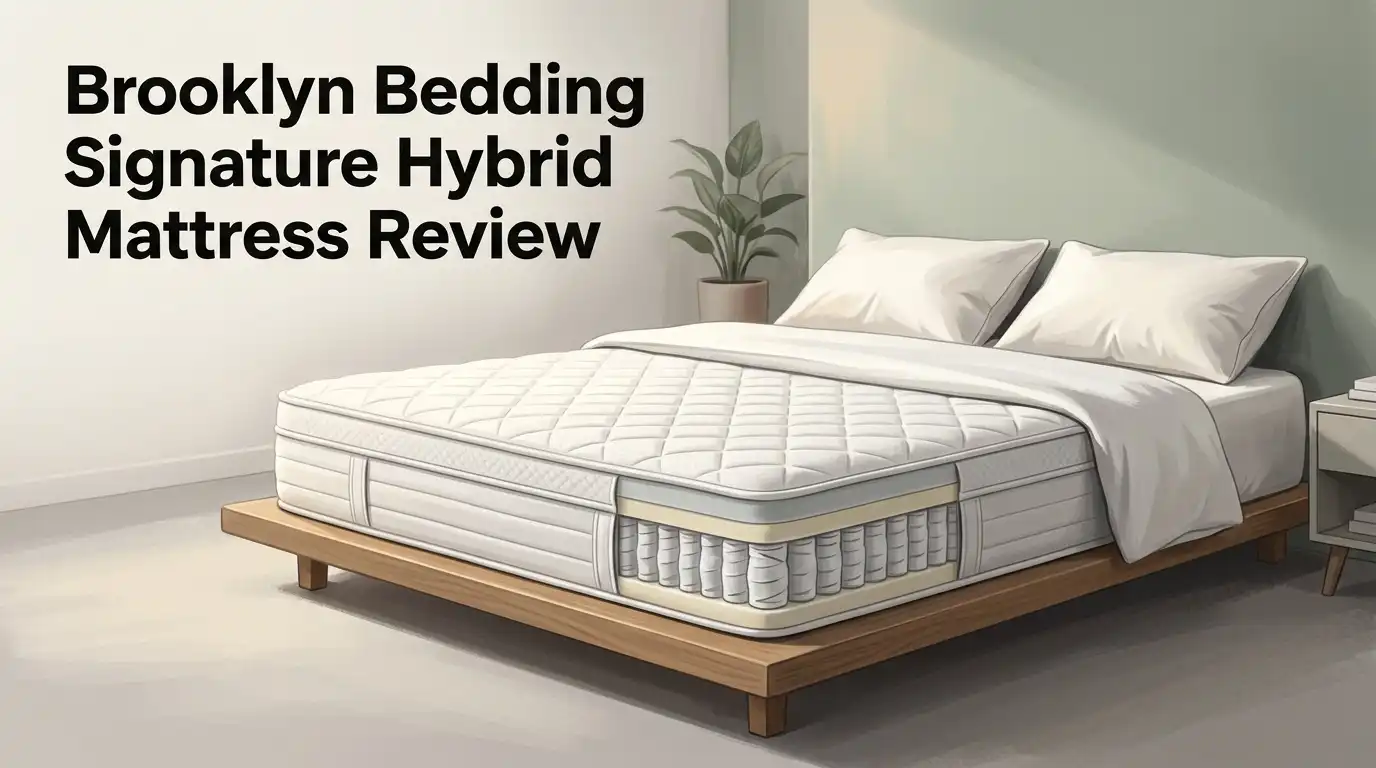
The layer stack explains the feel. On top sits an optional 2.5 inch Cloud Pillow Top at 1.5 PCF density. Below that comes one inch of gel swirl memory foam at 2.4 PCF, then 1.5 inches of poly foam at 2.5 PCF, then 0.75 inches of poly foam at 1.8 PCF.
The support side uses an eight inch pocketed coil unit. Inner coils run 15.5 gauge while outer perimeter coils run 14.75 gauge, which is thicker and stiffer. A 0.75 inch support foam base finishes the build.
Total comfort layer thickness reaches 5.75 inches, which is about 1.4 inches more than the category average. That extra foam is why pressure relief and motion isolation both score so well. The foam densities are fair rather than premium, which is the honest tradeoff at this price point.
Top 3 Alternatives for Brooklyn Bedding Signature Hybrid


Last update on 2026-10-28 / Affiliate links / Images from Amazon Product Advertising API
Nectar Premier Hybrid Mattress

Last update on 2026-10-26 / Affiliate links / Images from Amazon Product Advertising API
Linenspa 12 Inch Hybrid Mattress

Last update on 2026-10-27 / Affiliate links / Images from Amazon Product Advertising API
Novilla 12 Inch Hybrid Pillow Top Mattress
Firmness Options Explained
Picking the right firmness decides whether you love this bed or return it. Here is how the three options break down.
The soft version lands near 4 out of 10. It suits dedicated side sleepers who want their shoulder and hip to sink in deeply. Light sleepers under 150 pounds tend to prefer it.
The medium version measures about 6 out of 10, which is a true medium firm feel. This is the right pick for roughly 80% of buyers. It handles side, back, and stomach sleeping across most body weights.
The firm version sits near 8 out of 10. Stomach sleepers, heavier back sleepers, and anyone who hates sinking should choose it. Side sleepers usually find it punishing on the shoulder.
If you feel torn, choose medium. The 365 night trial gives you room to change your mind.
The Cloud Pillow Top Upgrade
Last update on 2026-10-28 / Affiliate links / Images from Amazon Product Advertising API
Brooklyn Bedding sells a 2.5 inch Cloud Pillow Top upgrade for about $200 extra on a queen. The question is whether that money buys real comfort.
It does, but only for certain sleepers. The pillow top adds noticeable cushioning at the shoulder and hip. Side sleepers and anyone with shoulder pain will feel the difference on night one. It also softens the overall feel by roughly half a point on the firmness scale.
Back and stomach sleepers get less benefit. The extra plushness increases sinkage, which can let the hips drop slightly below the shoulders. If you already know you prefer a firm, flat surface, skip the upgrade and save the money.
The upgrade pushes a queen from $1,099 to $1,299. Still reasonable, but no longer a budget purchase.
How It Feels for Side Sleepers
Side sleeping is where this mattress shines. Pressure mapping showed an average reading of 0.09 PSI at the shoulder and hip with a maximum of 0.27 PSI. Anything under 1.0 PSI counts as comfortable, so these numbers are excellent.
In practice my shoulder sank into the foam without hitting the coils. The hip stayed level with the spine instead of dropping. That alignment is what prevents morning lower back stiffness.
The medium version with the pillow top gave the best side sleeping experience. The soft version works too if you weigh under 150 pounds and want a deeper hug.
Side sleepers over 250 pounds should stick with medium rather than soft. The extra body weight already creates plenty of sinkage, and soft foam can let the hips sag too far.
Back and Stomach Sleeper Support
Back sleepers do well here. The eight inch coil unit pushes back firmly under the lumbar region. Pressure readings for back sleeping averaged 0.05 PSI, which is very low. I felt supported through the night with no lower back ache.
Stomach sleepers face a tougher call. Pressure readings jumped to an average of 0.70 PSI in that position, which is a meaningful increase. The 2.46 inch sinkage depth is deeper than average, and deep sinkage is the enemy of stomach sleeping.
If you sleep on your stomach more than half the night, order the firm version and skip the pillow top. That combination reduces sinkage and keeps your hips from dropping into a curved position. Combination sleepers who roll between positions should take the medium, since the fast response time makes switching easy.
Cooling Performance Tested
Brooklyn Bedding markets cooling heavily. The 2026 update added ThermoPhase, a phase change material in the cover, on top of the existing Glaciotex cooling fabric.
The cover does feel cool when you first touch it. That sensation is real and pleasant. Surface temperature testing measured a maximum of 90.5 degrees after 15 minutes of body contact, which is almost exactly average across hybrid mattresses.
The mattress cooled down 5.1 degrees in the first minute after I got off it, slightly faster than average. The coil layer helps air move through the core.
My honest read is that cooling is good, not exceptional. You will not wake up sweating the way you might on an all foam bed. But if you run genuinely hot, a cooling mattress protector or breathable sheets will still help.
Motion Transfer and Couples
This is the single strongest test result. Motion transfer measured an acceleration range of 5.05 m/s compared with an 8.80 m/s average. That is roughly 43% less movement crossing the bed.
The thick 5.75 inch comfort layer absorbs most of the energy. The pocketed coils move independently and soak up whatever is left. My partner got out of bed at night without waking me once.
Noise is also minimal. The coils stayed silent through position changes and pressure tests.
Here is the interesting part. Motion isolation is usually the price you pay for bounce, and bounce is usually the price you pay for motion isolation. The Signature Hybrid delivers both, with 10.16 inches of total bounce and class leading motion control. Couples get responsiveness and undisturbed sleep in the same bed.
Edge Support and Usable Surface
Sitting on the edge produced 3.25 inches of compression, which is better than the 3.87 inch average. I could put on shoes at the side of the bed without feeling like I was sliding off.
Lying directly on the edge felt solid in every position. Two rows of thicker 14.75 gauge coils run along the left and right sides and do real work.
There is a catch worth knowing. Those reinforced coils only run along the two long sides. The head and foot of the mattress have no perimeter reinforcement.
You will notice this if you habitually sleep near the foot of the bed or sit at the end. For most people it never comes up. The design choice keeps the price down, and I think that tradeoff is fair at $1,099.
What the Signature Hybrid Does Not Do Well
Honest reviews name the weak spots, so here they are.
Off gassing is strong on day one. Plan for a two or three day airing period before you sleep on it.
There is no zoned support. Firmness stays identical from head to foot. Beds with zoned coils give extra lumbar reinforcement, and this one does not.
Foam densities are mid tier. At 1.5 to 2.5 PCF, these foams are acceptable for the price but not luxury grade. Expect reasonable longevity rather than fifteen years of identical feel.
Deep sinkage divides opinion. Some owners love the hug. Stomach sleepers and anyone who wants to float on top of a mattress will not.
Scattered owner reports mention body impressions after a few years, which is common across foam hybrids in this price bracket. The lifetime warranty covers sagging beyond a specified depth, so keep your law tag and receipt.
Pros and Cons
Pros
- Three firmness options at no extra charge, which is rare for a boxed mattress
- Outstanding motion isolation, measured at roughly 43% below average
- High bounce of 10.16 inches makes movement and intimacy easy
- Strong edge support along both long sides with reinforced coils
- Excellent pressure relief for side sleepers, with very low PSI readings
- 365 night trial, free shipping, free returns, and a lifetime warranty
- Made in the brand’s own Arizona factory, fiberglass free and CertiPUR US certified
- Priced about 26% below the average hybrid mattress
Cons
- Strong chemical smell for the first two to three days after unboxing
- No zoned lumbar support anywhere in the coil unit
- No reinforced coils at the head or foot of the mattress
- Deeper than average sinkage can bother strict stomach sleepers
- Cooling is good rather than best in class despite heavy marketing
- The pillow top upgrade adds $200 to a queen
- Heavy at around 110 pounds, so you need help moving it
Price, Trial Period, and Warranty
Pricing with the standard cover runs about $719 for a twin, $999 for a full, $1,099 for a queen, and $1,399 for a king. With the Cloud Pillow Top, a queen moves to $1,299 and a king to $1,649. Brooklyn Bedding runs frequent sales, so the real price is often lower.
The policy package is where this brand pulls ahead. You get a 365 night trial, free shipping both ways, free returns with no restocking fee, and a lifetime warranty.
For context, the average mattress trial across the industry runs about 192 nights, and only 40% of brands offer a lifetime warranty. Brooklyn Bedding removed its old return fee, which used to be the biggest complaint about buying from them. That change makes trying this bed almost risk free.
Who Should Buy It and Who Should Skip It
Buy this mattress if you sleep on your side or back, share a bed with a restless partner, and want hybrid performance without spending $2,000. It also suits couples, combination sleepers, and anyone unsure about firmness, since three options plus a full year trial remove most of the guesswork.
Heavier sleepers up to 300 pounds are well served by the medium or firm version, thanks to the eight inch coil core and thick comfort layer.
Skip it if you sleep strictly on your stomach and hate sinking, unless you commit to the firm model without the pillow top. Skip it if you need zoned lumbar support for a diagnosed back condition, since this bed does not offer it. Also skip it if you are extremely sensitive to new product odors and cannot air out a room.
Final Verdict
The Brooklyn Bedding Signature Hybrid earns its reputation. It delivers measured performance that matches mattresses costing several hundred dollars more, especially in motion isolation, pressure relief, and edge support. The three firmness options solve the biggest problem with buying a bed online, which is guessing what feel you need.
It is not a perfect mattress. The off gassing is unpleasant for a few days. There is no zoned support. The cooling claims are slightly oversold. Stomach sleepers need to choose carefully.
But at $1,099 for a queen, with a full year to decide and free returns, the risk sits almost entirely with the company. That is a rare position for a shopper to be in. For most people looking at hybrid mattresses in 2026, this one belongs on the short list.
Frequently Asked Questions
How long does the Brooklyn Bedding Signature Hybrid take to expand?
The mattress reaches most of its height within two hours. It looks fully expanded by the next morning. Full foam recovery can take up to 48 hours, though you can sleep on it before then once the smell clears.
Is the Signature Hybrid good for back pain?
Many back pain sufferers do well on the medium version. The eight inch coil unit supports the lumbar region while the foam relieves shoulder and hip pressure. There is no zoned support, so people with severe diagnosed spinal conditions may want a bed with targeted lumbar reinforcement.
Does the Brooklyn Bedding Signature Hybrid sleep hot?
It sleeps cooler than an all foam mattress. The coil layer moves air through the core and the ThermoPhase cover feels cool on contact. Surface temperature testing landed near average, so very hot sleepers may still want breathable sheets or a cooling protector.
Can I use this mattress on an adjustable base?
Yes. The pocketed coil construction flexes well and the mattress performed normally on an adjustable base in testing. Check that your base supports a 14.5 inch profile and that your sheets are deep enough.
What firmness should I order?
Order medium unless you have a strong reason not to. Choose soft only if you are a dedicated side sleeper under 150 pounds. Choose firm if you sleep on your stomach or want minimal sinkage. The 365 night trial lets you exchange if the feel is wrong.
How long will the Signature Hybrid last?
Expect roughly seven to ten years of good service with regular rotation. The foam densities are mid tier, so some body impressions over time are normal. The lifetime warranty covers sagging that exceeds the stated depth limit.
Is the pillow top upgrade worth the extra cost?
For side sleepers and people with shoulder pain, yes. The extra 2.5 inches of cushioning makes a clear difference. Back and stomach sleepers gain little and may prefer the standard cover for less sinkage.

Hi, I’m Ava Day, the founder and lead writer at Cozy Bed Vault. I’m passionate about sleep wellness and dedicated to helping people find their perfect mattress. Through honest reviews, detailed comparisons, and expert buying guides, I simplify the mattress shopping experience so you can sleep soundly every night.